

What is a Conjunction? 🤔
Have you ever noticed how small words can connect big ideas in a sentence? Conjunctions work like bridges that link words and thoughts together, making our speaking and writing smoother and more meaningful. In this English Grammar topic, we will understand what conjunctions are and how they help us express ideas clearly. 📘
Meaning and Definition of Conjunction 📖
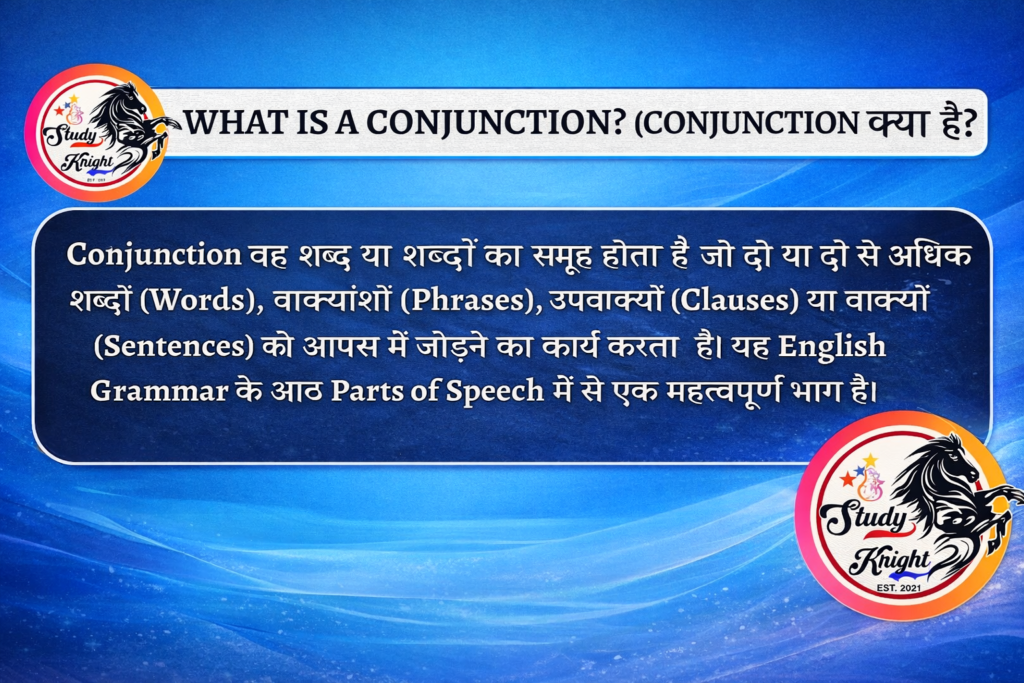
Conjunction वह शब्द या शब्दों का समूह होता है जो दो या दो से अधिक शब्दों (Words), वाक्यांशों (Phrases), उपवाक्यों (Clauses) या वाक्यों (Sentences) को आपस में जोड़ने का कार्य करता है। यह English Grammar के आठ Parts of Speech में से एक महत्वपूर्ण भाग है।
In simple words, a conjunction is a joining word that connects words, phrases, clauses, or sentences to make complete and meaningful expressions.
Examples ✅
• Rama and Hari are friends.
👉 यहाँ and शब्द Rama और Hari (दो words) को जोड़ रहा है।
• People’s ignorance and population explosion are closely related problems.
👉 यहाँ and दो phrases को जोड़ने का कार्य कर रहा है।
• She said that she would come.
👉 that दो clauses को जोड़ता है — She said + she would come।
• Mohan ran fast but he missed the train.
👉 but दो sentences को जोड़कर contrast दिखाता है।
• Two and two make four.
👉 यहाँ and दो words को जोड़ रहा है।
ऊपर दिए गए सभी वाक्यों में and, but, that conjunction (संयोजक) के उदाहरण हैं। 🌟
Frequently Used Conjunctions and Their Hindi Meanings 📘✨
नीचे दिए गए कुछ महत्वपूर्ण conjunctions रोज़मर्रा की English में काफी इस्तेमाल होते हैं। इनके हिन्दी अर्थ भी साथ में दिए गए हैं ताकि समझना आसान हो जाए। 👇
| # | Conjunction Words | Hindi Meaning |
| 1. | And | तथा / और |
| 2. | As well as | के साथ-साथ |
| 3. | Otherwise / Or else | अन्यथा / नहीं तो |
| 4. | So / Hence | इसलिए / इस कारण |
| 5. | Therefore / Consequently | अतः / फलस्वरूप |
| 6. | Either…or | या तो…या |
| 7. | Neither…nor | न…न ही |
| 8. | Both…and | दोनों…और |
| 9. | So…that | इतना…कि |
| 10. | Too…to | इतना…कि (कर पाना संभव न हो) |
| 11. | So…as | उतना…जितना |
| 12. | As…as | जितना…उतना |
| 13. | Whether…or | चाहे…या |
| 14. | As…so | जैसा…वैसा |
| 15. | As soon as | जैसे ही / तुरंत जब |
| 16. | But | पर / लेकिन / परन्तु |
| 17. | Or | या / अथवा / नहीं तो |
| 18. | No sooner…than | जैसे ही…वैसे ही |
| 19. | Not only…but also | केवल…ही नहीं बल्कि |
| 20. | Scarcely…when | मुश्किल से…कि |
| 21. | Wherever | जहाँ कहीं भी |
| 22. | Hardly…when | मुश्किल से…कि |
| 23. | Whenever | जब कभी भी |
| 24. | Where | जहाँ |
| 25. | While | के दौरान / जबकि |
| 26. | When | जब |
| 27. | As | क्योंकि / चूँकि |
| 28. | Until / Unless | तब तक…जब तक नहीं |
| 29. | Such…that | इतना…कि |
| 30. | Because | क्योंकि |
Types of Conjunctions 🔹📘
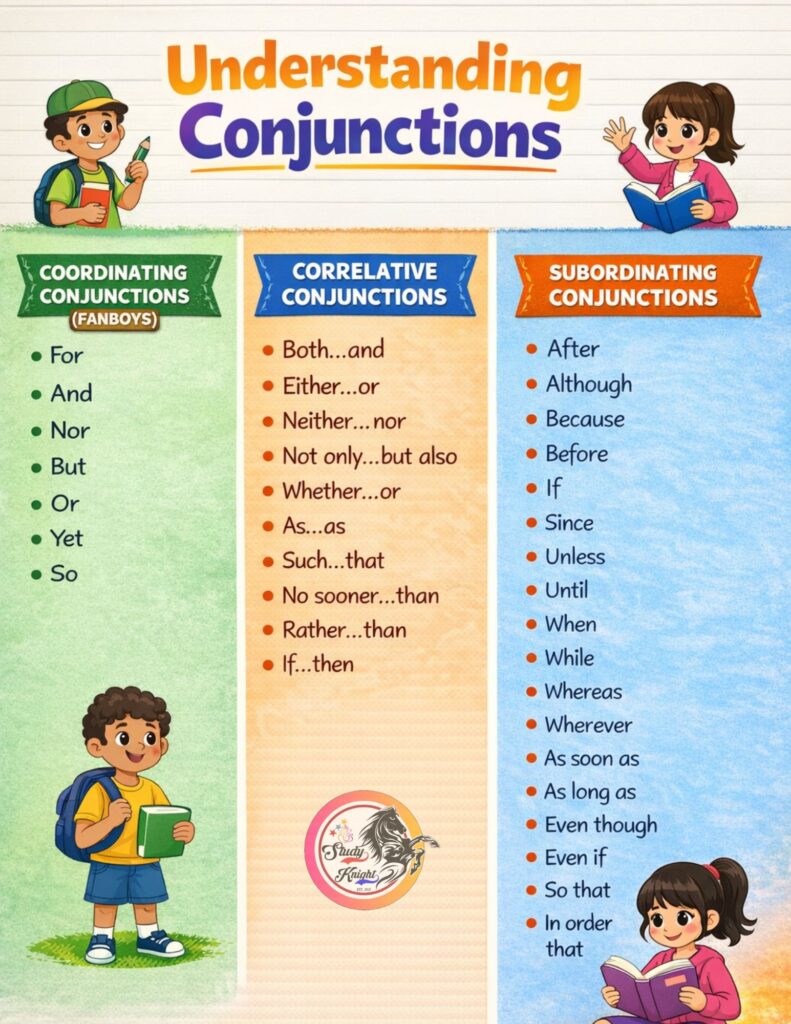
Conjunctions (संयोजक) मुख्य रूप से दो प्रकार के होते हैं, जिनका प्रयोग वाक्यों और विचारों को अलग-अलग तरीके से जोड़ने के लिए किया जाता है। 👇
1️⃣ Co-ordinating Conjunctions (समान पद संयोजक)
2️⃣ Subordinating Conjunctions (आश्रित संयोजक)
Co-ordinating Conjunction ✨
Co-ordinating Conjunction वह conjunction होता है जो समान स्तर (equal level) के शब्दों, वाक्यांशों या वाक्यों को आपस में जोड़ता है। यानी जिन भागों को जोड़ा जाता है, उनका महत्व समान होता है।
सरल शब्दों में — यह बराबर महत्व वाले ideas को connect करता है। 📖
Examples ✅
• Two and two make four.
👉 यहाँ and दो words को जोड़ रहा है।
• Kailash and Gopal are friends.
👉 and दो व्यक्तियों (words) को जोड़ता है।
• He passed but his sister failed.
👉 but दो opposite ideas वाले sentences को जोड़ता है।
• Mohan came here but Sushil went away.
👉 यहाँ but दो clauses को जोड़कर contrast दिखाता है।
ऊपर दिए गए उदाहरणों में and समान शब्दों को जोड़ता है, जबकि but दो अलग-अलग वाक्यों को आपस में connect करता है। 🌟
Kinds of Co-ordinating Conjunctions 📘✨
Co-ordinating Conjunctions (समानपदीय संयोजक) को उनके प्रयोग और अर्थ के आधार पर अलग-अलग प्रकारों में बाँटा जाता है। नीचे इनके मुख्य प्रकार दिए गए हैं — 👇
1️⃣ Cumulative (संयुक्त संयोजक)
2️⃣ Adversative (विरोध दर्शाने वाले संयोजक)
3️⃣ Alternative (विकल्प सूचक संयोजक)
4️⃣ Illative (परिणाम बताने वाले संयोजक)
Cumulative Conjunction 🌟
Cumulative Conjunction वह conjunction होता है जो एक विचार या कथन को दूसरे विचार के साथ जोड़कर जानकारी को आगे बढ़ाता है। यह सामान्यतः addition (कुछ और जोड़ने) का भाव प्रकट करता है।
अर्थात — एक action या idea के साथ दूसरा action जोड़ा जाता है। 📖
Examples ✅
• She came here and did her work.
👉 यहाँ and दो clauses को जोड़कर दोनों कार्यों को दर्शाता है।
• I went to Agra and visited the Taj.
👉 and दो actions को जोड़ रहा है।
• We opened our books and started reading.
👉 दोनों कार्य क्रम से जुड़े हुए हैं।
• God made the country and man built the town.
👉 दो statements को एक साथ जोड़ा गया है।
• Birds fly and fish swim.
👉 दो समान तथ्यों को जोड़ने के लिए and का प्रयोग हुआ है।
✅ ऐसे conjunctions वाक्य में अतिरिक्त जानकारी (addition) जोड़ने का कार्य करते हैं। ✨
Frequently Used Cumulative Conjunctions 📝✨
नीचे कुछ महत्वपूर्ण Cumulative दिए गए हैं, जिनका प्रयोग वाक्य में अतिरिक्त जानकारी या समान विचार जोड़ने के लिए किया जाता है। 👇
- Also
- And
- As well
- Both…and
- Too
- As well as
- Moreover
- Furthermore
- Besides
- In addition
- Additionally
- Similarly
- Likewise
- No less than
- Now
✅ इन का उपयोग किसी बात में extra information जोड़ने और ideas को आपस में connect करने के लिए किया जाता है। 🌟
Adversative – Showing Contrast or Opposition ⚖️✨
Adversative Conjunction (विरोधदर्शक संयोजक) ऐसे conjunctions होते हैं जिनका प्रयोग दो अलग या विपरीत विचारों (opposite ideas) को आपस में जोड़ने के लिए किया जाता है। इनमें दूसरा भाग पहले कथन के विपरीत अर्थ या contrast को दर्शाता है। 📘
सरल भाषा में — ये विरोध या अंतर दिखाने के लिए उपयोग किए जाते हैं।
Examples ✅
• He is slow but he is sure.
👉 यहाँ but दो विपरीत विचारों को जोड़ रहा है।
• He is intelligent but he is not diligent.
👉 but contrast को स्पष्ट करता है।
• I was angry, still I kept quiet.
👉 still विरोध के बावजूद होने वाली स्थिति को दिखाता है।
इन उदाहरणों में but और still दो विरोधी कथनों को जोड़ रहे हैं, इसलिए इन्हें Adversative Conjunctions कहा जाता है। 🌟
Common Adversative (Contrast Showing Words) ⚖️📘
नीचे कुछ महत्वपूर्ण Adversative दिए गए हैं, जिनका प्रयोग वाक्य में विरोध, अंतर या contrast दिखाने के लिए किया जाता है। 👇
- Yet
- Still
- However
- Nevertheless
- Only
- While
- Whereas
- On the other hand
- Conversely
- In contrast
- Despite
- But
✅ इन का उपयोग तब किया जाता है जब दो विचार एक-दूसरे के विपरीत या अलग अर्थ व्यक्त करते हों। 🌟
Alternative Conjunctions – Expressing Choice or Option 🔀✨
Alternative (वैकल्पिक संयोजक) ऐसे conjunctions होते हैं जिनका प्रयोग दो विकल्पों या choices को जोड़ने के लिए किया जाता है। इन विकल्पों में से सामान्यतः केवल एक को ही चुना जाता है। 📘
सरल शब्दों में — यह “या तो यह, या वह” जैसी स्थिति को दर्शाता है।
Examples ✅
• She must weep or she must die.
👉 यहाँ दो विकल्प दिए गए हैं — (i) She must weep, (ii) She must die.
• Walk quickly else you will miss the train.
👉 विकल्प — (i) जल्दी चलो, (ii) ट्रेन छूट जाएगी।
• Make haste otherwise you will be late.
👉 दो संभावित स्थितियों को जोड़ा गया है।
• Either come with me or go to the library.
👉 दो choices में से एक चुनना है।
• Either sit silently or leave the room.
👉 यहाँ भी केवल एक विकल्प स्वीकार्य है।
✅ ऐसे वाक्य में विकल्प (choice), संभावना या alternative situation को व्यक्त करते हैं। 🌟
Common Alternative (Choice Showing Words) 🔀📘
नीचे दिए गए वाक्य में विकल्प (choice) या alternative situation व्यक्त करने के लिए उपयोग किए जाते हैं। 👇
- Either…or
- Neither…nor
- Or
- Whether…or
- Rather…or
- Else
- Instead
- Otherwise
- Not…but
- Not only…but also
✅ इन conjunctions का प्रयोग तब किया जाता है जब वाक्य में दो संभावित विकल्पों में से किसी एक को चुनना हो। 🌟
Illative Conjunctions – Showing Result or Conclusion 📘✨
Illative Conjunction (परिणामसूचक संयोजक) ऐसे conjunctions होते हैं जिनका प्रयोग दो वाक्यों को जोड़ने के लिए किया जाता है, जहाँ एक वाक्य दूसरे वाक्य का परिणाम (result), निष्कर्ष (conclusion) या कारण से निकला हुआ प्रभाव दर्शाता है।
अर्थात — दूसरा कथन पहले कथन का परिणाम बताता है। 📖
Examples ✅
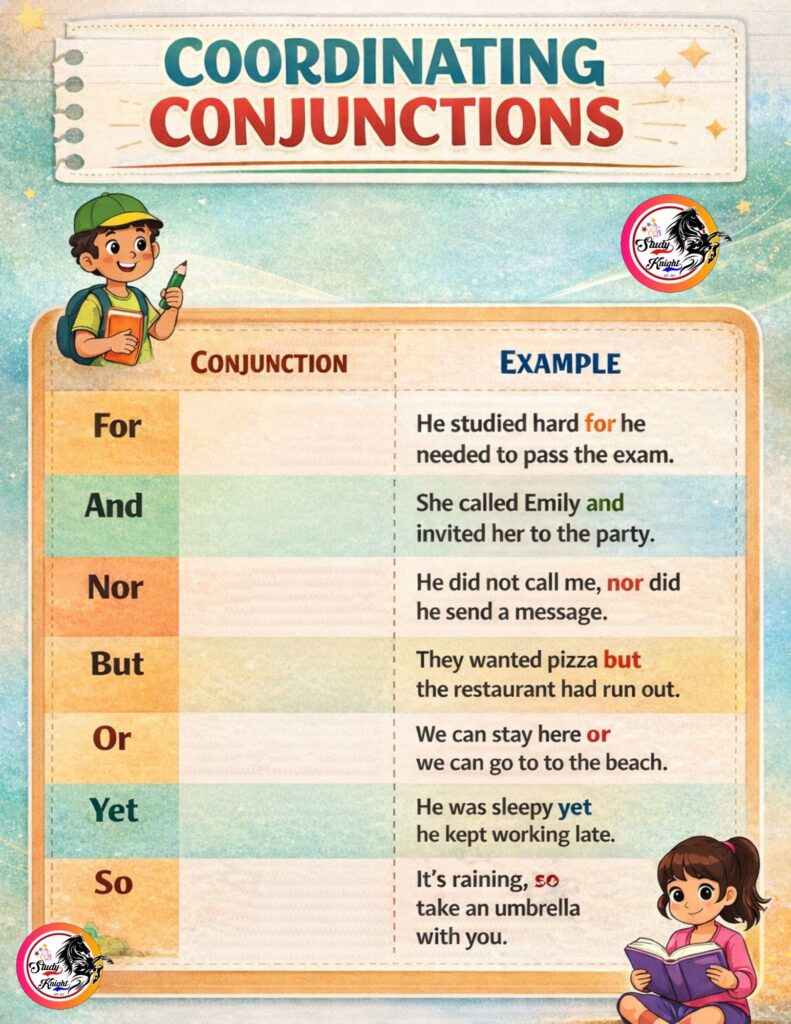
• Something fell in; for I heard a splash.
👉 यहाँ दूसरा वाक्य पहले कथन का कारण/परिणाम स्पष्ट करता है।
• All precautions must have been neglected; for the cholera spread.
👉 for पहले कथन की पुष्टि करता है।
• There must be someone at the door; for I hear a knock.
👉 दूसरा वाक्य पहले का reason बताता है।
ऊपर दिए गए प्रत्येक उदाहरण में दो sentences जुड़े हैं, जहाँ for परिणाम या निष्कर्ष को जोड़ने का कार्य कर रहा है। इसलिए for यहाँ Illative Conjunction के रूप में प्रयोग हुआ है। 🌟
Common Illative Conjunctions 📝
For
So
Thus
Consequently
Hence
Accordingly
As a result
✅ इन conjunctions का उपयोग किसी कार्य के परिणाम, निष्कर्ष या effect को व्यक्त करने के लिए किया जाता है। ✨
Subordinating Conjunctions – Joining Main and Dependent Clauses 📘✨
Subordinating Conjunction (आश्रित संयोजक) वह conjunction होता है जो एक आश्रित उपवाक्य (Subordinate Clause) को मुख्य वाक्य (Main Clause) से जोड़ता है। आश्रित उपवाक्य अपने आप पूर्ण अर्थ नहीं देता, बल्कि मुख्य वाक्य पर निर्भर रहता है। 📖
सरल शब्दों में — यह main idea और dependent idea को आपस में connect करता है।
Examples ✅
• When father came, I was reading a book.
= I was reading a book when father came.
👉 यहाँ when father came आश्रित उपवाक्य है।
• If you work hard, you will pass.
= You will pass if you work hard.
👉 if subordinate clause को main clause से जोड़ रहा है।
ऊपर दिए गए वाक्यों में subordinate clause का पहला शब्द (when, if) ही Subordinating Conjunction कहलाता है। 🌟
Common Subordinating Conjunctions 📝
After, Because, If, That, Though, Although, While, How, Until, Till, Before, Unless, As, When, Where, Since, Than
Examples of Subordinating Conjunctions ✅
• He slept after he had finished the work.
• He passed because he worked hard.
• I shall help you if you come to me.
• He said that honesty is the best policy.
• Though he was ill, he passed.
• Although you are rich, you are not proud.
• Wait till father comes.
• He had finished his work before he slept.
• Unless you work harder, you will not pass.
• Do as I tell you.
• When he came, I was sleeping.
• Stay where you are.
• Since he was not there, I spoke to his father.
• The earth is larger than the moon.
• Make hay while the sun shines.
• I do not know how it happened.
• I will stay here until you return.
Important Usage Notes 📌
✅ Since, As, Because → कारण (Reason) प्रकट करते हैं।
✅ Till / Until → समय (Time) दर्शाते हैं।
👉 Till प्रायः positive sense में और Until negative sense में प्रयोग होता है।
✅ Unless → शर्त (Condition) बताता है। (Unless = If not)
✅ When / While → समयसूचक conjunctions हैं।
✅ Though / Although → समान अर्थ रखते हैं, अर्थ — यद्यपि।
🌟 इस प्रकार Subordinating Conjunctions वाक्य में कारण, समय, शर्त, तुलना और स्थिति को स्पष्ट रूप से व्यक्त करने में मदद करते हैं।
Uses of Subordinating Conjunctions – Functions and Examples 📘✨ Subordinating Conjunctions का प्रयोग वाक्य में अलग-अलग प्रकार के संबंधों को व्यक्त करने के लिए किया जाता है, जैसे — Time, Cause/Reason, Purpose, Consequence, Condition, Comparison, Concession तथा Manner आदि। 👇
1️⃣ Time (समय) ⏰
जब किसी कार्य के होने का समय बताना हो, तब subordinating conjunctions का उपयोग किया जाता है।
• I was reading a book when he came.
• He had gone before you arrived.
• He went away after you had slept.
• Wait till mother cooks food.
👉 यहाँ when, before, after, till समय (Time) को व्यक्त कर रहे हैं।
2️⃣ Cause or Reason (कारण) 📖
जब किसी घटना का कारण या वजह बतानी होती है, तब इन conjunctions का प्रयोग किया जाता है।
• She got good marks because she worked hard.
• The child is crying because he is hungry.
• He failed as he was careless.
• As you were asleep, I did not disturb you.
• Since you are here, I shall help you.
• Since I get a small salary, I cannot afford a scooter.
👉 इन वाक्यों में because, as, since कारण (Reason) को दर्शा रहे हैं।
✅ इस प्रकार subordinating conjunctions समय और कारण के संबंध को स्पष्ट रूप से समझाने में मदद करते हैं। 🌟
3️⃣ Purpose (उद्देश्य) 🎯
जब किसी कार्य के पीछे का उद्देश्य या मकसद बताना हो, तब subordinating conjunctions का प्रयोग किया जाता है।
• He goes into the room so that he may write a letter.
• He went into the room so that he might write a letter.
• We eat so that we may live.
• He lives so that he may eat.
• Walk carefully lest you should fall down.
• He held my hand lest I should fall.
👉 ऊपर दिए गए वाक्यों में that (so that) और lest उद्देश्य (Purpose) को व्यक्त कर रहे हैं।
📌 Important Points
✅ That / So that → “ताकि” के अर्थ में प्रयुक्त होता है।
✅ Lest → निषेधात्मक (Negative ) conjunction है।
👉 इसका अर्थ होता है — “कहीं ऐसा न हो”।
✅ Lest के बाद सामान्यतः should helping verb का प्रयोग किया जाता है।
✅ Lest के बाद not नहीं लगाया जाता क्योंकि lest स्वयं ही negative अर्थ देता है।
4️⃣ Result or Consequence (परिणाम) 📊
जब किसी कार्य का परिणाम या effect बताना हो, तब subordinating conjunction का प्रयोग किया जाता है।
• I am so old that I cannot work hard.
• I was so tired that I could not work.
• He is so poor that he cannot buy books.
• She was so ill that she could not go to school.
• You are so poor that you cannot pay your fee.
👉 इन सभी वाक्यों में that परिणाम (Result / Consequence) को दर्शा रहा है।

✅ इस प्रकार subordinating conjunctions किसी कार्य के उद्देश्य और उसके परिणाम को स्पष्ट रूप से व्यक्त करने में सहायता करते हैं। 🌟
5️⃣ Condition (शर्त) ✅
जब किसी कार्य के होने के लिए कोई शर्त (condition) बताई जाती है, तब subordinating conjunctions का प्रयोग किया जाता है।
• You will pass if you work hard.
• If you come to me, I shall help you.
• He will go if you accompany him.
• I will not come unless I am invited.
• You will not get your admission unless you return all the library books.
• Unless you tell the truth, you will be punished.
👉 इन वाक्यों में if और unless शर्त (Condition) को व्यक्त कर रहे हैं, इसलिए ये Subordinating Conjunctions हैं।
📌 Important Points
✅ If → Positive condition दर्शाता है।
✅ Unless → Negative condition को व्यक्त करता है।
👉 Unless = If not (यदि नहीं)।
6️⃣ Comparison (तुलना) ⚖️
जब दो व्यक्तियों, वस्तुओं या कार्यों के बीच तुलना (comparison) की जाती है, तब subordinating conjunction का प्रयोग किया जाता है।
• Rama is fatter than Mohan (is).
• I am stronger than you (are).
• The fox was cleverer than the crow.
• We speak faster than we write.
👉 ऊपर दिए गए वाक्यों में than तुलना (Comparison) को दर्शा रहा है, इसलिए इसका प्रयोग Subordinating Conjunction of Comparison के रूप में हुआ है।
✅ इस प्रकार subordinating conjunctions शर्त और तुलना को स्पष्ट रूप से व्यक्त करने में सहायता करते हैं। 🌟
7️⃣ Concession (रिआयत / छूट) 🤝
जब किसी वाक्य में अपेक्षा के विपरीत परिणाम या concessive idea (यद्यपि… फिर भी) व्यक्त किया जाता है, तब subordinating conjunctions का प्रयोग किया जाता है।
• Although he worked hard, he failed.
• Though he did not read at all, he passed.
• Though he is poor, yet he is happy.
• Although I was tired, yet I kept working.
👉 इन वाक्यों में although / though रिआयत या concession का भाव व्यक्त कर रहे हैं।
📌 Important Points
✅ Though → Although का छोटा (short) रूप माना जाता है।
✅ Modern English में although/though के साथ दूसरे clause में yet लगाना आवश्यक नहीं होता।
✔ Although/Though you are poor, you are happy. (Correct)
✔ Although/Though you are poor, yet you are happy. (Correct)
❌ Although/Though you are poor, but you are happy. (Incorrect)
👉 Although / Though के साथ but का प्रयोग नहीं किया जाता।
👉 चाहें तो दूसरे clause में yet का प्रयोग किया जा सकता है, यह optional होता है।
8️⃣ Manner (रीति या विधि) 🧭
जब किसी कार्य के करने के तरीके या विधि (manner) को बताया जाता है, तब subordinating conjunction का प्रयोग किया जाता है।
• He may do as he likes.
• She did as she was asked.
• You may do as you please.
👉 यहाँ as कार्य करने की विधि (manner) को स्पष्ट कर रहा है, इसलिए यह Subordinating के रूप में प्रयुक्त हुआ है।
📌 Important Note
✅ As से सामान्यतः Noun Clause नहीं बनती है; इसका प्रयोग प्रायः manner दर्शाने के लिए किया जाता है।
🌟 इस प्रकार subordinating conjunctions concession और manner दोनों प्रकार के संबंधों को स्पष्ट रूप से व्यक्त करने में सहायता करते हैं।
Compound Conjunctions – in Group Form 📘✨
जब एक शब्द के बजाय शब्दों के समूह (group of words) के रूप में प्रयोग किए जाते हैं, तब उन्हें Compound Conjunction कहा जाता है। ये वाक्य में विशेष अर्थ या संबंध को स्पष्ट करने का कार्य करते हैं।
कुछ सामान्य Compound हैं —
In order that, On condition that, As though, As well as, As soon as, Even if, So that, Provided that, As if आदि।
Examples ✅
• In order that: The announcement was made in order that everyone might know the new exam date.
• On condition that: I will give you money on condition that you do not misuse it.
• Even if: She will succeed in life even if she faces early failures.
• So that: We eat so that we may live.
• Provided that: You may take any dress provided that you return it after the party.
• As though: He behaves as though he were very rich.
• As well as: Ram as well as his friends has come to the party.
• As soon as: The farmers will sow the seeds as soon as it rains.
• As if: He scolded me as if he were my father.
✅ Compound conjunctions sentence में purpose, condition, comparison और manner जैसे संबंधों को स्पष्ट करते हैं। 🌟
Correlative Conjunctions – Conjunctions Used in Pairs 🔗✨
जो जोड़े (pairs) में प्रयोग किए जाते हैं, उन्हें Correlative Conjunctions कहा जाता है। ये वाक्य के दो भागों को संतुलित रूप से जोड़ते हैं।
Common Correlative Conjunctions 📝
Either…or
Neither…nor
Both…and
So…that
Too…to
So…as
As…as
Whether…or
As…so
No sooner…than
Not only…but also
Scarcely…when
Hardly…when
Such…that
Lest…should
Although/Though…yet
Examples ✅
• Neither his friends nor his parents knew about his evil intention.
• I do not know whether he will come or not.
🌟 Correlative conjunctions sentence में balance और emphasis बनाने में मदद करते हैं।
Pairs of Conjunctions and Their Usage 🔗📘
कुछ conjunctions ऐसे होते हैं जिनका प्रयोग जोड़े (pairs) में किया जाता है। इन्हें Correlative Pairs of Conjunctions भी कहा जाता है क्योंकि ये वाक्य के दो भागों को संतुलित रूप से जोड़ते हैं। नीचे इनके प्रमुख प्रकार और उदाहरण दिए गए हैं — 👇
1️⃣ Either…or (या तो…या)
दो विकल्पों में से किसी एक को चुनने के लिए प्रयोग किया जाता है।
• Either you can have chocolate ice cream or vanilla ice cream.
• We can either go to the park or stay at home.
2️⃣ Neither…nor (न तो…न)
जब दोनों विकल्पों को नकारना (negative meaning) हो।
• Neither Sarah nor James could attend the party.
• The movie was neither interesting nor exciting.
3️⃣ Both…and (दोनों…और)
दो व्यक्तियों या वस्तुओं को एक साथ जोड़ने के लिए।
• She is both smart and kind.
• We have both apples and oranges.
4️⃣ So…that (इतना…कि)
किसी कार्य का परिणाम या प्रभाव बताने के लिए।
• It was raining so heavily that we couldn’t go outside.
• He ran so fast that he won the race.
5️⃣ Too…to (इतना…कि)
किसी कार्य को करने में असमर्थता (inability) व्यक्त करने के लिए।
• The box was too heavy to lift.
• She is too tired to go to the party.
6️⃣ So…as (इतना…जितना)
तुलना (comparison) के negative form में अधिक प्रयोग होता है।
• He is not so tall as his brother.
• She is not so fast as her friend.
7️⃣ As…as (जितना…उतना)
दो व्यक्तियों या वस्तुओं की समानता बताने के लिए।
• The cat is as cute as the kitten.
• He is as good at math as his sister.
8️⃣ Whether…or (या…या)
दो संभावनाओं या स्थितियों को दर्शाने के लिए।
• I don’t know whether to choose pizza or pasta.
• We can go to the beach whether it is sunny or cloudy.
9️⃣ As…so (जैसा…वैसा)
दो कार्यों या परिणामों के बीच संबंध दिखाने के लिए।
• As he worked hard, so his grades improved.
• She sings beautifully, as does her sister.
🔟 No sooner…than (जैसे ही…वैसे ही)
एक कार्य के तुरंत बाद दूसरे कार्य के होने को दर्शाता है।
• No sooner did he arrive home than it started raining.
• No sooner had she finished cooking than the guests arrived.
✅ ये paired conjunctions वाक्य में balance, comparison, choice और result को स्पष्ट रूप से व्यक्त करने में मदद करते हैं। 🌟
Use of As soon as, As well as, As if and Even if 📘✨
नीचे दिए गए compound conjunctions के प्रयोग को ध्यानपूर्वक समझिए, क्योंकि ये वाक्य के अर्थ और संरचना को विशेष रूप से प्रभावित करते हैं। 👇
1️⃣ Use of As soon as ⏱️
As soon as का प्रयोग तब किया जाता है जब एक कार्य के तुरंत बाद दूसरा कार्य होता है।
• As soon as he heard the news, he wrote to me.
👉 इसी अर्थ को दूसरे तरीके से भी लिखा जा सकता है —
• No sooner did he hear the news than he wrote to me.
📌 Important Points
✅ As soon as → Positive structure है।
✅ No sooner…than → Negative structure माना जाता है।
✅ No sooner के साथ हमेशा than का प्रयोग होता है।
✅ As soon as से Adverb Clause बनती है और इसके बाद Principal Clause आता है।
✅ Adverb Clause के बाद comma ( , ) लगाया जाता है।
✅ No sooner वाला clause प्रश्नवाचक संरचना (inversion) में बनता है, लेकिन अंत में (?) नहीं लगाया जाता।
✅ Than से Adverb Clause शुरू होती है।
2️⃣ Use of As well as ➕
As well as का अर्थ होता है — साथ ही / के साथ-साथ।
• Rama as well as his brother passed.
• You as well as I are innocent.
📌 Rule:
✅ Verb हमेशा As well as से पहले वाले Subject के अनुसार आती है।
3️⃣ Use of As if 🎭
As if का अर्थ होता है — मानो / जैसे कि।
• He looks as if he were weary.
📌 Important Rule:
✅ As if के बाद hypothetical या imaginary sense में were का प्रयोग किया जाता है।
👉 यहाँ were का अर्थ वास्तविक भूतकाल नहीं बल्कि कल्पित स्थिति दर्शाता है।
4️⃣ Use of Even if 🌧️
Even if का अर्थ होता है — यद्यपि / भले ही (condition के बावजूद)।
• I will go there even if it rains.
👉 इसका प्रयोग ऐसी स्थिति बताने के लिए होता है जहाँ परिणाम condition के बावजूद नहीं बदलता।
✅ इन conjunctions का सही प्रयोग sentence structure, meaning और grammar accuracy को मजबूत ब
Test Yourself – Identify the Conjunctions 📝✨
नीचे दिए गए वाक्यों में Conjunction को पहचानिए और बताइए कि वे Co-ordinating Conjunction हैं या Subordinating Conjunction। 👇
- Rahul and Aman are brothers.
👉 and — Co-ordinating Conjunction - She arrived after her mother had gone out.
👉 after — Subordinating Conjunction - I waited till the train arrived.
👉 till — Subordinating Conjunction - Do not go before I return.
👉 before — Subordinating Conjunction - He cannot give you any money, for he has none.
👉 for — Co-ordinating Conjunction - He was sorry because you did not help him.
👉 because — Subordinating Conjunction - He is richer than his elder brother.
👉 than — Subordinating Conjunction - Catch me if you can.
👉 if — Subordinating Conjunction - Is that story true or false?
👉 or — Co-ordinating Conjunction - If I feel any doubt, I ask.
👉 if — Subordinating Conjunction - We can travel by land or water.
👉 or — Co-ordinating Conjunction - The sun is bigger than the earth.
👉 than — Subordinating Conjunction - I hear that your brother is in Gorakhpur.
👉 that — Subordinating Conjunction - He may enter as he is a friend.
👉 as — Subordinating Conjunction - We eat that we may live.
👉 that — Subordinating Conjunction
Summary of Conjunctions 📘🌟
Conjunctions छोटे लेकिन अत्यंत महत्वपूर्ण शब्द होते हैं जो words, phrases और clauses को आपस में जोड़ते हैं। ये वाक्य में संबंध (relationship) स्पष्ट करते हैं, अतिरिक्त जानकारी जोड़ते हैं और भाषा को अधिक व्यवस्थित तथा प्रभावशाली बनाते हैं।
Conjunctions की सहायता से हमारी writing और speaking दोनों अधिक clear, connected और effective बनती हैं। ✨