

Prepositions inEnglish : Meaning, Definition, Rules and Examples
English grammar includes many important elements that help us form clear and meaningful sentences, and prepositions are one of them. There are more than 100 prepositions used in English, but only a few are commonly used in daily communication such as in, on, at, under, between, and near.
In this article, you will learn the meaning of prepositions, their definition, usage rules, and different examples that explain how they connect words within a sentence. Let’s understand this topic step by step in a simple way.
What is a Preposition in English?
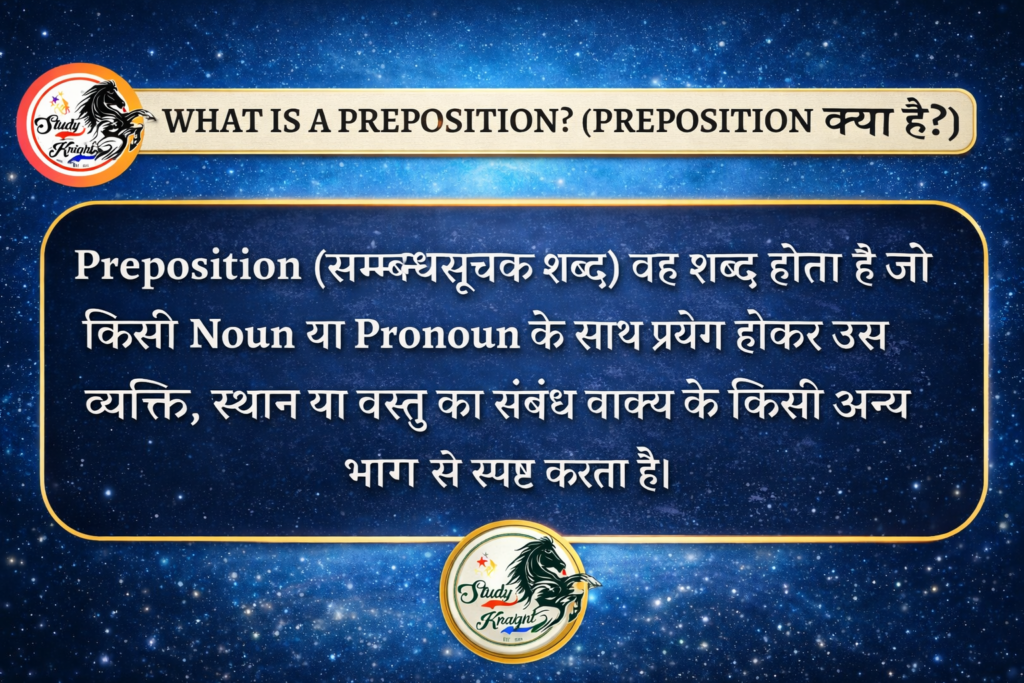
Preposition (सम्बन्धसूचक शब्द) वह शब्द होता है जो किसी Noun या Pronoun के साथ प्रयोग होकर उस व्यक्ति, स्थान या वस्तु का संबंध वाक्य के किसी अन्य भाग से स्पष्ट करता है।
In English grammar, a preposition is a word placed before or sometimes after a noun or pronoun to show the relationship of that noun or pronoun with another word in the sentence. This relationship may indicate place, time, direction, cause, or manner. The word preposition comes from the Latin language, where “prae” means before and “ponere” means to place. Therefore, a preposition usually appears before the word it connects.
Examples of Prepositions
The cat is sleeping on the sofa.
Rahul is interested in painting.
The children are playing near the playground.
इन वाक्यों में on, in, near Prepositions के रूप में प्रयोग किए गए हैं क्योंकि ये शब्द अन्य शब्दों के बीच संबंध दिखा रहे हैं।
Important Note
Prepositions हमेशा noun या pronoun से पहले ही आएँ, ऐसा जरूरी नहीं है। कुछ sentences में ये अंत में भी आ सकते हैं, जैसे:
Whom are you waiting for?
This is the project I was working on.
Commonly Used Prepositions
English में frequently इस्तेमाल होने वाले कुछ मुख्य prepositions इस प्रकार हैं:
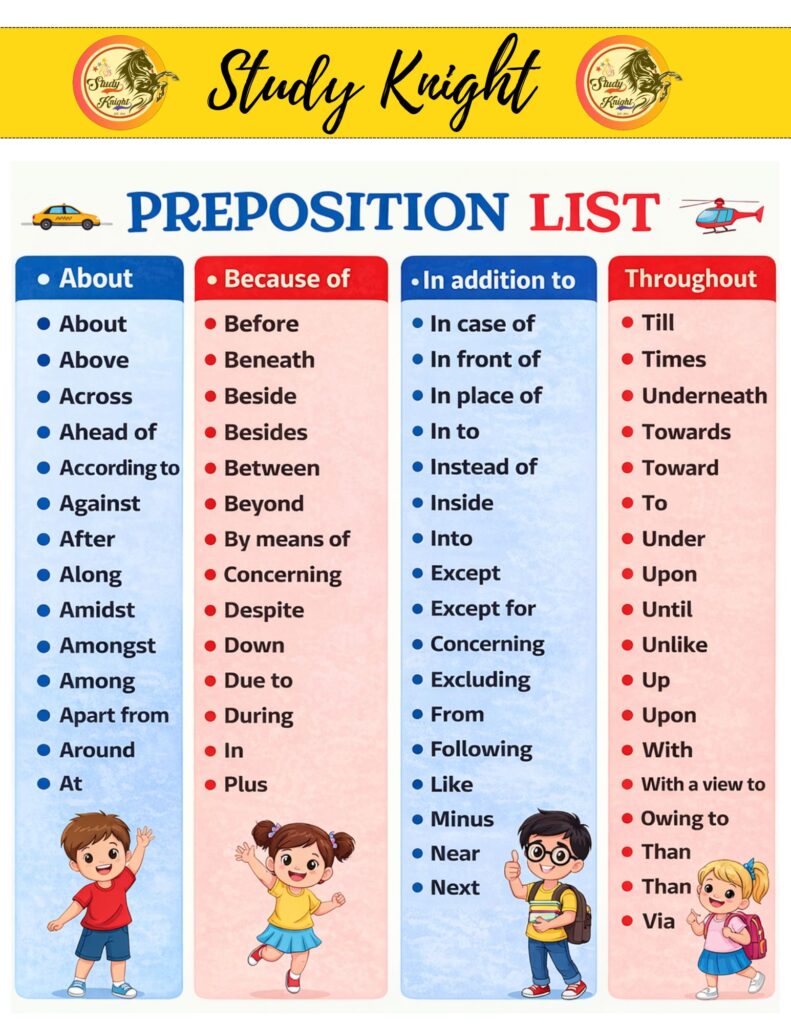
in, on, at, by, with, from, to, for, over, under, between, among, into, out of, before, after, about, through आदि।
Types of Prepositions in English Grammar
English grammar में Prepositions को उनके structure और usage के आधार पर अलग-अलग categories में बाँटा जाता है. सामान्यतः Prepositions तीन प्रकार के होते हैं 👇
✅ Simple Prepositions
✅ Compound Prepositions
✅ Phrase Prepositions (Complex Prepositions)
अब इनको आसान भाषा में समझते हैं।
✏️ Simple Prepositions
Simple Prepositions ऐसे prepositions होते हैं जो केवल एक शब्द (single word) के होते हैं और sentence के दो भागों के बीच संबंध (relationship) दिखाते हैं।
ये daily English speaking और writing में सबसे ज्यादा इस्तेमाल किए जाते हैं.
👉 Common Simple Prepositions:
in, on, at, to, from, with, by, for, under, over, near, through, up, down आदि।
🌟 Examples of Simple Prepositions
- In: The documents are kept in the folder. 📂
- On: The mobile phone is on the shelf. 📱
- At: We will meet at the entrance gate. 🚪
- To: Riya went to the library. 📚
- Of: He bought a glass of juice. 🥤
- From: They travelled from Jaipur yesterday. 🚆
- With: The boy is writing with a blue pen. ✍️
- By: The bridge was designed by an engineer. 🏗️
- Up: The kite flew up in the sky. 🪁
- Down: The leaves fell down from the tree. 🍃
- Through: The train passed through the tunnel. 🚇
- Under: The rabbit hid under the bush. 🌿
- Out: She stepped out of the room quietly. 🚶
- Near: The hospital is near the market. 🏥
🔹 Compound Prepositions
Compound Prepositions वे prepositions होते हैं जो दो शब्दों के मेल से बने होते हैं। सामान्यतः ये किसी basic preposition को noun, adjective या adverb के साथ जोड़कर बनाए जाते हैं, जिससे sentence में relationship और स्पष्ट हो जाता है ✨.
👉 Common Compound Prepositions:
about, across, among, between, before, behind, beneath, beyond, inside, outside, towards आदि।
ये prepositions direction, position, situation या relation को detail में express करने के लिए उपयोग किए जाते हैं.
🌟Examples of Compound Prepositions in English
- About (के बारे में): We discussed about the upcoming event in class. 📝
- Among (के बीच): The teacher distributed chocolates among the students. 🍫
- Amongst (बीच में): He felt comfortable amongst his close friends. 👥
- Amid (के बीच): The ceremony continued amid loud applause. 👏
- Amidst (बीच में): The players practiced amidst heavy fog. 🌫️
- Against (के खिलाफ): She spoke against unfair rules. ⚖️
- Above (ऊपर): A bright star shone above the mountains. ⭐
- Towards (की ओर): The child ran towards his mother. 👩👦
- Across (आर-पार): They walked across the bridge together. 🌉
- Along (के साथ-साथ): We cycled along the river road. 🚴
- Around (आस-पास): Tourists gathered around the monument. 🏛️
- Behind (पीछे): The car was parked behind the building. 🚗
- Below (नीचे): The temperature dropped below zero at night. 🌡️
- Before (पहले): Please finish your work before dinner. 🍽️
- Beside (बगल में): He sat beside his brother during the show. 🎭
- Beneath (के नीचे): Fish were swimming beneath the clear water. 🐟
- Between (के बीच): The café is located between two shops. ☕
- Beyond (आगे): The village lies beyond the hills. ⛰️
- Inside (अंदर): Everyone waited inside the hall. 🏫
- Outside (बाहर): The children are playing outside the house. 🏡
- Underneath (नीचे): The shoes were hidden underneath the bed. 👟
🔶 Phrase Prepositions (Complex Prepositions)
Phrase Prepositions — जिन्हें Complex Prepositions भी कहा जाता है — ऐसे prepositions होते हैं जो दो या दो से अधिक शब्दों से मिलकर बनते हैं। ये पूरे phrase की तरह काम करते हैं और sentence में relation को अधिक स्पष्ट और detailed बनाते हैं 📘✨।
👉 Common Phrase Prepositions:
according to, because of, due to, in front of, in spite of, in order to, by means of, on behalf of, in addition to, with reference to आदि।
ये prepositions अक्सर formal English, writing, exams और daily communication में उपयोग किए जाते हैं.
🌟 Examples of Phrase Prepositions
- According to (के अनुसार):
According to the teacher, regular practice improves grammar skills. 👩🏫 - Because of (के कारण):
The match was cancelled because of heavy rain. 🌧️ - By means of (के द्वारा):
The workers lifted the materials by means of a machine. ⚙️ - Due to (के कारण):
The train was delayed due to technical issues. 🚆 - For the sake of (के लिए):
She moved to another city for the sake of her career. 🎓 - In addition to (के अतिरिक्त):
In addition to English, he is learning French. 🌍 - In case of (स्थिति में):
In case of emergency, contact the security office immediately. 🚨 - In front of (सामने):
A beautiful garden stands in front of the building. 🌼 - In order to (के लिए / उद्देश्य से):
She woke up early in order to complete her assignment. ⏰ - In spite of (के बावजूद):
In spite of the difficulties, they achieved success. 🏆 - Instead of (के बजाय):
He chose tea instead of coffee. ☕ - On account of (के कारण):
The office remained closed on account of a public holiday. 📅 - On behalf of (की ओर से):
She accepted the award on behalf of her team. 🏅 - Owing to (के कारण):
The event was postponed owing to bad weather. 🌩️ - With reference to (संदर्भ में):
With reference to your application, we will reply soon. 📄
Double Prepositions
Double Prepositions वे prepositions होते हैं जो दो prepositions के मिलकर बनने से तैयार होते हैं। जब दो शब्द एक साथ आकर sentence में एक ही prepositional meaning देते हैं, तो उन्हें Double Preposition कहा जाता है 📘✨।
कई बार ये structure prepositional phrase जैसा काम करता है, इसलिए कुछ grammarians इन्हें phrase-type prepositions की category में भी शामिल करते हैं।
👉 Common Double Prepositions:
into, onto, upon, within, without, throughout, out of, next to, from behind, from within आदि।
ये direction, position, movement या condition को अधिक स्पष्ट रूप से व्यक्त करते हैं.
🌟 Examples of Double Prepositions
- Into (में अंदर):
The students rushed into the classroom after the bell rang. 🔔 - Inside (अंदर):
The documents are safely kept inside the locker. 🔐 - Throughout (पूरे समय / हर जगह):
Lights remained on throughout the festival night. 🎉 - Up to (तक):
The road goes up to the mountain village. 🏔️ - Upon (जैसे ही / ऊपर):
Upon receiving the message, he replied immediately. 📩 - Within (के भीतर):
Please submit the form within two days. ⏳ - Without (बिना):
She completed the project without any help. 💻 - Out of (से बाहर):
The bird flew out of the cage. 🕊️ - Next to (के पास):
A pharmacy is located next to the hospital. 🏥 - Onto (पर ऊपर):
The child climbed onto the chair carefully. 🪑 - From above (ऊपर से):
Snow slowly fell from above the hills. ❄️ - From behind (पीछे से):
Someone called my name from behind the gate. 🚪 - From under (नीचे से):
The puppy came from under the table. 🐶 - From within (भीतर से):
A loud cheer came from within the stadium. ⚽ - Outside of (के बाहर):
They built a house outside of the town area. 🏡 - Off to (के लिए रवाना):
The team left off to participate in the competition. 🏆 - Over to (की ओर):
She walked over to the help desk for assistance. 🧭
Participle Prepositions
Participle Prepositions ऐसे prepositions होते हैं जो verb (क्रिया) के participle form से बनते हैं। इनमें verb और preposition — दोनों के गुण पाए जाते हैं, इसलिए ये sentence में एक special grammatical role निभाते हैं 📘✨।
आमतौर पर इन शब्दों के अंत में –ing या –ed जुड़ा होता है और ये पूरे sentence के साथ relation establish करते हैं।
👉 Common Participle Prepositions:
concerning, regarding, considering, excluding, including, given, pending आदि।
🌟 Examples of Participle Prepositions
- Concerning (के संबंध में):
Concerning your application, we will contact you soon. 📄 - Regarding (के बारे में):
The manager spoke regarding the new company policy. 🏢 - Excluding (को छोड़कर):
Excluding holidays, the library opens daily. 📚 - Considering (ध्यान में रखते हुए):
Considering his experience, he was selected for the job. 💼 - Given (को देखते हुए):
Given the weather conditions, the trip was postponed. 🌧️ - Including (शामिल करते हुए):
The package cost covers everything, including meals. 🍽️
📝 Important Note
Prepositions का कोई बिल्कुल fixed classification नहीं होता ⚠️।
अलग-अलग grammar books में एक ही preposition को अलग category में रखा जा सकता है।
👉 उदाहरण के लिए:
- Near को कुछ books में Simple Preposition माना जाता है, जबकि कुछ में Compound.
- कुछ grammarians Phrase Prepositions और Compound Prepositions को एक ही category में भी रखते हैं।
इसलिए classification से ज्यादा usage समझना महत्वपूर्ण होता है ✅।
📗 Rules for Using Prepositions (Prepositions का सही प्रयोग)
अब कुछ महत्वपूर्ण rules देखते हैं जो exams और daily English दोनों में बहुत useful हैं 👇
⏱️ 1. Use of “In” and “After”
✅ In का प्रयोग future time period (कितने समय में) बताने के लिए होता है।
✅ After बताता है कि कार्य कितने समय बाद होगा।
Examples:
- I will complete the project in three days.
- He will call you after two hours.
📍 2. Use of “In” and “At”
✅ At छोटे या specific place के लिए प्रयोग होता है।
✅ In बड़े शहर, राज्य या देश के लिए प्रयोग किया जाता है।
Examples:
- She lives at Green Park Colony. 🏘️
- He works in Mumbai. 🌆
🧭 3. Use of “Behind” and “After”
✅ Behind → place (स्थान) दर्शाता है।
✅ After → time (समय) दर्शाता है।
Examples:
- The bicycle is parked behind the house. 🚲
- They left the hall after the program ended. ⏰
⚒️ 4. Use of “By”, “With” and “From”
✅ By → doer / agent (किसके द्वारा)
✅ With → instrument or tool (किस साधन से)
✅ From → separation or source (किससे अलग / स्रोत)
Examples:
- The letter was written by Rohan. ✍️
- He cut the paper with scissors. ✂️
- The leaf fell from the branch. 🍃
📘 Important Uses of Prepositions (Advanced Usage Rules)
अब हम कुछ ऐसे important prepositions rules सीखेंगे जो exams ✍️, grammar practice 📚 और daily English speaking 🗣️ — तीनों के लिए बहुत useful हैं।
🔹 Use of “Beside” and “Besides”
✅ Beside का अर्थ होता है — निकट / पास में (by the side of)
✅ Besides का अर्थ होता है — अतिरिक्त / इसके अलावा (in addition to)
🌟 Examples:
- Please sit beside me during the meeting. 🪑
- A lamp was placed beside the bed. 💡
- Besides mathematics, she also studies science. 📘
Besides winning the prize, he received special recognition. 🏆
⏰ Use of “By” and “Till”
✅ By → निश्चित समय सीमा (deadline) दर्शाता है।
✅ Till / Until → किसी समय तक जारी रहने वाली क्रिया को दर्शाता है।
🌟 Examples:
- Submit the assignment by tomorrow evening. 📄
- She will reach home by 9 PM.
- I will stay here till you return. ⌛
- They waited till the shop opened. 🏬
🕒 Use of “Since” and “For”
इन दोनों का प्रयोग समय बताने के लिए Perfect Tenses में किया जाता है।
✅ Since → निश्चित समय (Point of Time)
✅ For → समय की अवधि (Period of Time)
⚠️ Future Perfect Continuous tense में Since का प्रयोग नहीं होता।
🌟 Examples:
- He has lived here for five years. 🏡
- She has been studying since morning. 🌅
- They have been working for three hours. ⏳
- I have known him since 2022.
Past Perfect Continuous:
- She had been waiting for an hour.
- He had been teaching since July.
Future Perfect Continuous:
- By next month, I will have been working here for two years. ✅
🪑 Use of “On” and “Upon”
✅ On → स्थिर (static) स्थिति के लिए
✅ Upon → अचानक या motion वाली action के लिए
🌟 Examples:
- The bag is on the table. 🎒
- He rested on the sofa.
- The dog jumped upon the chair suddenly. 🐕
- The tiger sprang upon its prey. 🐅
🧭 Use of “To” and “Into”
✅ To → सामान्य दिशा या movement
✅ Into → अंदर की ओर movement (entering action)
🌟 Examples:
- She walked to the office. 🏢
- They travelled to Jaipur last week. 🚗
- The child ran into the room. 🏃
- The ball fell into the water. ⚽
🌅 Use of “Till” and “To”
✅ Till → समय (Time) दर्शाता है
✅ To → स्थान या दिशा (Place/Direction) दर्शाता है
🌟 Examples:
- He studied till midnight. 🌙
- We waited till sunrise. 🌄
- She walked to the bus stand. 🚏
- They moved to another city. 🌆
🔶 Use of “Between”, “Among” and “Amongst”
ये तीनों prepositions देखने में समान लगते हैं, लेकिन इनका प्रयोग अलग-अलग situations में किया जाता है 📘✨।
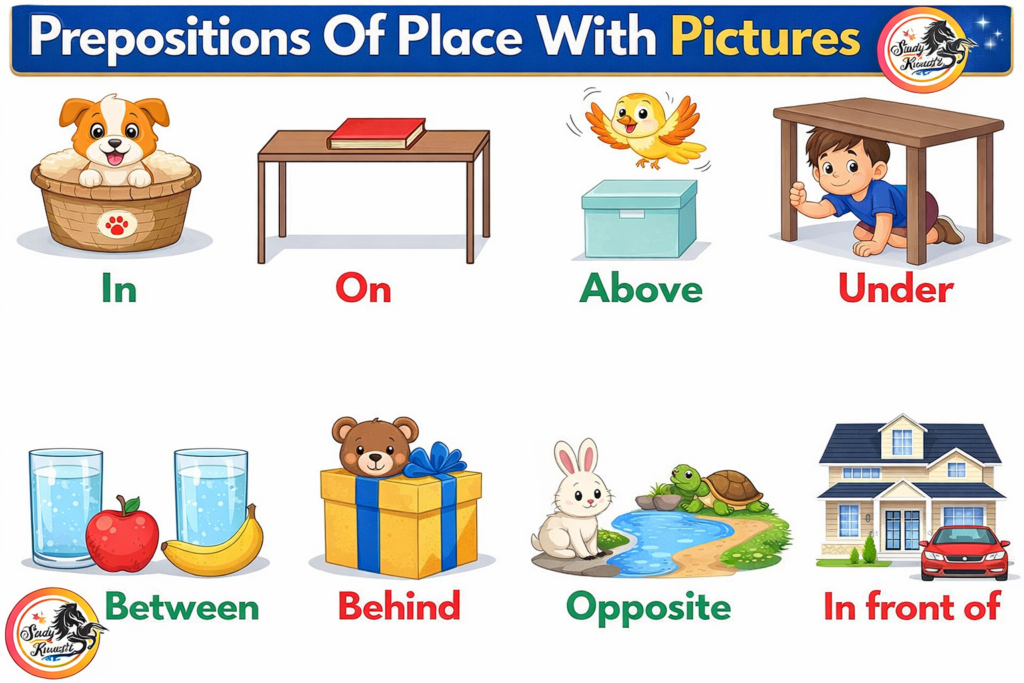
✅ Between → दो व्यक्तियों या वस्तुओं के लिए
✅ Among → दो से अधिक (कुछ) व्यक्तियों या वस्तुओं के लिए
✅ Amongst → बहुत अधिक संख्या या formal usage में
🌟 Examples:
- The prize was shared between Rohan and Karan. 🏆
- The sweets were distributed among the students in the class. 🍬
- The responsibilities were divided amongst all team members. 👥
🔹 Use of “From”
From preposition के मुख्यतः दो महत्वपूर्ण प्रयोग होते हैं 👇
✅ 1. Separation (अलगाव / स्रोत) दिखाने के लिए
जब किसी व्यक्ति, स्थान या वस्तु से अलग होने का भाव व्यक्त करना हो।
Examples:
- She returned from Chandigarh yesterday. 🚆
- The painting fell from the wall. 🖼️
✅ 2. Point of Time (निश्चित समय) बताने के लिए
इस प्रयोग में From किसी कार्य की शुरुआत का समय दर्शाता है और यह किसी भी tense में आ सकता है।
Examples:
- Classes will start from Monday. 📅
- I started preparing from last week.
- He has been working from morning. ⏰
📍 Position of Prepositions in a Sentence
English grammar में preposition का मुख्य काम sentence के words के बीच relationship establish करना होता है। सामान्यतः preposition अपने object (noun/pronoun) से पहले आता है।
👉 Structure:
Preposition + Noun / Pronoun = Prepositional Phrase
🌟 Examples:
- She walked to the market. 🛒
- He is sitting on the bench. 🪑
- The puppy is hiding under the table. 🐶
📝 Sentence Analysis (Structure Understanding)
Example 1:
👉 The book is on the desk.
- Subject: The book
- Verb: is
- Preposition: on
- Object of Preposition: desk
यहाँ desk noun है और इसका संबंध on के माध्यम से book से जुड़ रहा है।
Example 2:
👉 She came with me yesterday.
- Subject: She
- Verb: came
- Preposition: with
- Object: me (Pronoun)
यहाँ me preposition with का object है।
✅ Conclusion:
Preposition के बाद आने वाला Noun या Pronoun, उस preposition का Object कहलाता है और वही sentence में relationship को स्पष्ट करता है 📚✨।
📌 Position of Prepositions in a Sentence
English grammar में Preposition वाक्य के आरम्भ (beginning), मध्य (middle) या अन्त (end) — कहीं भी आ सकता है। इसका स्थान sentence की structure और meaning पर निर्भर करता है 📘✨।
🌟 Examples:
- I bought this gift for you. 🎁
- Besides Ramesh, many students joined the competition. 🏫
- This is the book you were searching for. 📚
- That is the person I was talking about.
- What are you looking at? 👀
- Which chair did you sit on? 🪑
👉 ऊपर दिए गए sentences में for, besides, about, at, on सभी Prepositions हैं और कई बार sentence के अंत में भी आए हैं।
🔗 Relationship Expressed by Prepositions
Prepositions sentence में अलग-अलग प्रकार के relationships (सम्बन्ध) को व्यक्त करते हैं। आइए इन्हें आसान तरीके से समझते हैं 👇
⏰ 1. Relationship of Time (समय संबंध)
कुछ prepositions समय (time) को व्यक्त करने के लिए प्रयोग होते हैं।
🌟 Examples:
- The meeting starts at 9 a.m. ⏰
- She wakes up at sunrise every day. 🌅
- Office hours are from 10 to 5. 🏢
- There are 365 days in a year. 📅
- I will finish the task before Monday.
👉 यहाँ at, from, to, in, before समय का संबंध दिखा रहे हैं।
📍 2. Relationship of Place (स्थान संबंध)
कुछ prepositions स्थान या position को दर्शाते हैं।
🌟 Examples:
- The children are playing in the garden. 🌳
- A guard is standing at the entrance. 🚪
- She returned from college early. 🎓
- Keep the files on the desk. 📂
- He stood before the audience confidently. 🎤
👉 यहाँ prepositions स्थान को स्पष्ट कर रहे हैं।
⚙️ 3. Relationship Showing Agency or Instrument (माध्यम)
जब किसी कार्य के करने वाले (agent) या साधन (instrument) को बताना हो, तब कुछ विशेष prepositions प्रयोग होते हैं।
✅ By → व्यक्ति या doer
✅ With → औजार / instrument
✅ Through → माध्यम / channel
🌟 Examples:
- The report was prepared by the manager. 👨💼
- She opened the box with a key. 🔑
- The message was sent through email. 📧
- The building was damaged by fire. 🔥
- The painting was created by an artist. 🎨
📝 Note:
👉 Person → By
👉 Tool/Instrument → With
🎯 4. Relationship Showing Manner (कार्यविधि)
कुछ prepositions यह बताते हैं कि कोई कार्य कैसे किया गया।
🌟 Examples:
- He solved the puzzle without help. 🧩
- She faced the problem with confidence. 💪
- They completed the work with great care.
- The team won the match with ease. 🏏
🎯 5. Relationship Showing Cause or Purpose (कारण / उद्देश्य)
Cause (कारण) या purpose (उद्देश्य) व्यक्त करने के लिए अक्सर of और for का प्रयोग किया जाता है।
🌟 Examples:
- He died of a serious illness. 🏥
- The patient suffered of high fever.
- She works hard for her family. 👨👩👧
- They raised funds for social welfare. ❤️
🔗 Relation Showing Source, Origin and Inference
(स्रोत, उद्गम और निष्कर्ष का संबंध)
Preposition “From” का प्रयोग किसी चीज़ के source (स्रोत), origin (उद्गम) या reason/inference (निष्कर्ष) को व्यक्त करने के लिए किया जाता है 📘✨।
🌟 Examples:
- These lines are taken from a famous poem. 📖
- I received this letter from my uncle. ✉️
- Plants get energy from sunlight. ☀️
- Success comes from continuous effort. 💪
- He helped me from genuine kindness. ❤️
📏 Relation Showing Measure and Rate
(माप और मूल्यदर का संबंध)
✅ By → Measure (माप) दिखाने के लिए
✅ At → Rate or price (मूल्यदर) बताने के लिए
🌟 Examples:
- Fabric is sold by the meter. 🧵
- Oil is measured by the litre.
- It is 6 p.m. by my watch. ⌚
- Apples are selling at ₹120 per kilo. 🍎
- He is taller than his brother by three inches. 📏
⚖️ Relation Showing Contrast and Concession
(विरोध या छूट का भाव)
कुछ prepositions contrast (विरोध) या concession (छूट/बावजूद) को व्यक्त करते हैं।
🌟 Examples:
- After many attempts, success may still take time.
- For all his achievements, he remains humble. 🌟
- With all her difficulties, she completed the task. ✅
📘 Prepositions Used After Verbs
English में कई verbs ऐसे होते हैं जिनके साथ specific prepositions ही प्रयोग किए जाते हैं। Meaning के अनुसार verb के बाद preposition बदल जाता है।
नीचे कुछ महत्वपूर्ण combinations दिए गए हैं 👇
🔹 1. Use of “At”
- She is looking at the painting. 🎨
- The train stopped at the platform. 🚉
- He knocked at the door loudly. 🚪
- Do not laugh at others.
- My brother is good at mathematics. 📘
- The meeting started at 10 a.m. ⏰
🔹 2. Use of “About”
- We were talking about the project. 💼
- She is worried about her exams. 📚
- Be careful about your decisions.
- I know little about this topic.
🔹 3. Use of “By”
- The story was written by a young author. ✍️
- He travels by bus every day. 🚌
- Some machines run by electricity. ⚡
- She sat by the window reading a book. 🪟
- He will reach home by evening.
🔹 4. Use of “In”
- I believe in hard work. 💪
- The keys are in my bag. 🎒
- She succeeded in her mission. 🎯
🔹 5. Use of “For”
👉 “For” बहुत अधिक verb–preposition combinations में प्रयोग होता है।
- I am waiting for my friend. 👥
- She cares for her parents deeply. ❤️
- We are searching for a solution. 🔎
- He hopes for success. 🌟
- This book is written for beginners. 📘
- There is a strong demand for skilled workers.
🔹 6. Use of “From”
- These ideas come from experience. 📚
- The prisoner escaped from jail.
- The fruit fell from the tree. 🍎
- She bought vegetables from the market. 🛒
🔹 7. Use of “Of”
Preposition “Of” का प्रयोग possession, relation, cause, quality या association दिखाने के लिए किया जाता है 📘✨।
🌟 Examples:
- What are the benefits of morning exercise? 🌅
- There is little hope of success without effort.
- She has a habit of reading daily. 📚
- He lives in the hope of a better future.
- The colour of this flower is beautiful. 🌸
- One leg of the chair is broken. 🪑
- I am fond of classical music. 🎵
- This is the topic we were talking of.

🔹 8. Use of “On”
On का प्रयोग opinion, dependence, position और topic को व्यक्त करने के लिए किया जाता है।
🌟 Examples:
- What is your opinion on this matter? 🤔
- The cat is sitting on the wall. 🐈
- My notebook is on the desk. 📒
- We had a discussion on environmental issues. 🌍
- You can rely on me anytime. ✅
🔹 9. Use of “To”
To direction, relation, comparison, feeling और connection दर्शाने के लिए प्रयोग होता है।
🌟 Examples:
- Fresh air is essential to good health. 🌿
- The dog is loyal to its owner. 🐕
- She is grateful to her mentor. 🙏
- Your answer is similar to mine.
- Students should be obedient to their teachers. 👩🏫
- He applied to the manager for leave. 📄
- This car belongs to my brother. 🚗
- Please listen to the instructions carefully. 🎧
🔹 10. Use of “With”
With का प्रयोग companionship, instrument, feeling या condition दिखाने के लिए होता है।
🌟 Examples:
- Are you upset with me? 😄
- I fully agree with your idea.
- The hills are covered with snow. ❄️
- He cut the rope with a knife. 🔪
- She completed the task with confidence. 💪
📘 Prepositions Used After Adjectives & Past Participles
कुछ Adjectives और Past Participles (Verb की Third Form) के बाद specific prepositions का प्रयोग किया जाता है। ये combinations English grammar में बहुत important माने जाते हैं ✨।
🔹 Use of “About” (Adjectives + About)
- We must be careful about our safety. ⚠️
- She is worried about her results. 📊
🔹 Use of “With” (Adjectives + With)
- He is angry with his friend.
- She is busy with her project. 💻
- I am familiar with this software.
🔹 Use of “Of” (Adjectives / Participles + Of)
- She is proud of her achievements. 🏆
- I am sure of his honesty.
- He is fond of reading novels. 📖
- The traveller was tired of waiting.
- He was accused of cheating.
🔹 Use of “In” (Adjectives / Participles + In)
- She is interested in painting. 🎨
- He is experienced in teaching.
- The officer was negligent in his duty.
They are honest in their dealings
🔹 Use of “For” (Adjectives / Participles + For)
- You are eligible for this scholarship. 🎓
- Exercise is good for health. 💪
- I am responsible for this work.
- He is prepared for any challenge. 🚀
- Use of Preposition as an Adverb
- English grammar में कुछ शब्द ऐसे होते हैं जो कभी Preposition और कभी Adverb की तरह प्रयोग किए जाते हैं 📘✨।
जैसे — in, on, up, out, off, before, after, since, about आदि। - 📊 Preposition vs Adverb (Comparison Table)
| Preposition (Object के साथ) | Adverb (Object के बिना) |
| Do not worry about him. | Please move about freely. |
| Rahul is in the classroom. | Rahul has just come in. |
| The keys are on the desk. | Let us carry on. |
| He jumped off the bus. | The lights went off. |
| She returned after a week. | He arrived soon after. |
| I have not met him since Monday. | I haven’t seen her since. |
| I arrived before you. | I had never visited there before. |
📝 Exercise 1 – Fill in the Blanks (Prepositions Practice)
नीचे दिए गए वाक्यों को सही Prepositions चुनकर पूरा कीजिए। हर sentence के साथ options brackets में दिए गए हैं 📘✨।
✏️ Questions
1️⃣ There is a temple __________ that hill.
(on, at, in, over)
2️⃣ Spread this carpet __________ the floor.
(on, at, over, under)
3️⃣ Don’t run __________ pleasures.
(after, before, behind, for)
4️⃣ The play was __________ to begin.
(about, in, on, over)
5️⃣ I woke up __________ 5 o’clock.
(on, at, in, over)
6️⃣ I returned from my office __________ 8 o’clock daily.
(at, on, for, since)
7️⃣ Sita sits __________ Kamala and Kunti.
(among, between, amongst)
8️⃣ Look __________ this picture.
(at, on, over)
9️⃣ He depended __________ his friend’s word.
(at, on, over)
🔟 The child was afraid __________ the policemen.
(of, for, about)
📝 Exercise 2 – Fill in the Blanks (Prepositions Practice)
नीचे दिए गए sentences को brackets में दिए गए सही Prepositions की सहायता से पूरा कीजिए 📘✨।
👉 Options: (by, from, for, since)
✏️ Questions
1️⃣ We should profit __________ experience.
2️⃣ He kept the fast __________ a week.
3️⃣ King Vikram was famous __________ his justice.
4️⃣ Nelson is famous __________ his victory at Trafalgar.
5️⃣ Fetch a book __________ the boy.
6️⃣ She made a new dress __________ Rojeria.
7️⃣ The child fell __________ a great height.
8️⃣ The first prize was won __________ a young boy.
9️⃣ He has been suffering from fever __________ yesterday.
🔟 The boy was bitten __________ a dog.
📝 Exercise 3 – Fill in the Blanks (Prepositions Practice)
नीचे दिए गए sentences को सही Prepositions से पूरा कीजिए 📘✨।
👉 Options: (at, to, with, in, on)
✏️ Questions
1️⃣ She did not come here __________ 3 o’clock.
2️⃣ Have you cut your finger __________ a knife?
3️⃣ I congratulate you __________ your success in the examination.
4️⃣ He was born __________ Gomat in U.P.
5️⃣ Today I woke up __________ 8 o’clock.
6️⃣ Mr. Gupta met me __________ Sunday.
7️⃣ Look __________ that picture.
8️⃣ Come __________ me to the market.
9️⃣ She could not go __________ her mother’s village.
🔟 While flying __________ Bombay, Mr. Anil had a brief stopover at Udaipur.