

Vocabulary: Meaning, Importance, Types and Effective Ways to Improve !
Introduction (परिचय)
भाषा मनुष्य के विचारों को व्यक्त करने का सबसे प्रभावी माध्यम है। किसी भी भाषा को सही ढंग से समझने और उपयोग करने के लिए शब्दों का ज्ञान अत्यंत आवश्यक होता है। शब्दों के इसी संग्रह को Vocabulary कहा जाता है। यदि किसी व्यक्ति की vocabulary मजबूत होती है, तो वह अपनी बात स्पष्ट, प्रभावशाली और आत्मविश्वास के साथ प्रस्तुत कर सकता है।
आज के समय में English language का महत्व शिक्षा, प्रतियोगी परीक्षाओं, नौकरी और दैनिक जीवन के communication में लगातार बढ़ रहा है। बहुत से विद्यार्थी grammar सीख लेते हैं, लेकिन vocabulary की कमी के कारण वे अपनी बात सही तरीके से व्यक्त नहीं कर पाते। इसलिए vocabulary development भाषा सीखने की प्रक्रिया का आधार माना जाता है।
Vocabulary केवल शब्द याद करना नहीं है, बल्कि शब्दों का अर्थ, सही उच्चारण, प्रयोग और संदर्भ को समझना भी है। जब कोई learner शब्दों को context के साथ सीखता है, तब language learning अधिक प्रभावी हो जाती है।
What is Vocabulary?
Vocabulary refers to the collection of words that a person knows and uses in a particular language.
It includes understanding meanings, pronunciation, spelling, and proper usage of words in communication.
सरल शब्दों में कहा जाए तो यह उन सभी शब्दों का ज्ञान है जिन्हें हम सुनते, पढ़ते, बोलते और लिखते समय उपयोग करते हैं।
Example:
Word: Confident
Meaning: Feeling sure about one’s abilities
Sentence: She spoke confidently during the presentation.
यह language learning की foundation होती है क्योंकि बिना शब्दों के किसी भी भाषा में communication संभव नहीं है।
Components of Vocabulary
यह केवल शब्दों की सूची नहीं होती बल्कि इसके कई महत्वपूर्ण घटक होते हैं:
1. Meaning (अर्थ)
किसी शब्द का सही अर्थ समझना आवश्यक है, क्योंकि गलत अर्थ communication को गलत बना सकता है।
2. Pronunciation (उच्चारण)
सही pronunciation से speaking skills बेहतर होती हैं और listener को समझने में आसानी होती है।
3. Spelling (वर्तनी)
सही spelling writing skills के लिए आवश्यक है।
4. Usage (प्रयोग)
हर शब्द का प्रयोग अलग context में होता है, इसलिए sentence usage सीखना जरूरी है।
Example:
Word: Run
Sentence 1: He runs every morning.
Sentence 2: The machine runs smoothly.
दोनों sentences में word same है लेकिन meaning context के अनुसार बदल रहा है।
Types of Vocabulary
इसे सामान्यतः चार प्रमुख भागों में बाँटा जाता है:
1. Listening Vocabulary
यह उन शब्दों का समूह है जिन्हें हम सुनकर समझ सकते हैं। जब हम conversations, lectures या videos सुनते हैं !
2. Speaking Vocabulary
यह उन शब्दों को दर्शाती है जिन्हें हम बोलते समय actively उपयोग करते हैं। यह communication skills का महत्वपूर्ण हिस्सा है।
Example:
“I would like to explain my idea clearly.”
3. Reading Vocabulary
यह उन शब्दों से संबंधित है जिन्हें हम पढ़ते समय पहचान लेते हैं और उनका अर्थ समझते हैं।
4. Writing Vocabulary
यह सबसे advanced स्तर माना जाता है क्योंकि इसमें learner शब्दों का सही और प्रभावी प्रयोग लिखते समय करता है।
Importance of Vocabulary (Vocabulary का महत्व)
Vocabulary का महत्व भाषा सीखने के हर स्तर पर दिखाई देता है।
1. Effective Communication
जब शब्दों का ज्ञान अधिक होता है, तब व्यक्ति अपनी बात स्पष्ट रूप से व्यक्त कर सकता है।
2. Improvement in Reading Skills
अधिक vocabulary होने से reading speed और comprehension दोनों बढ़ते हैं।
3. Better Writing Ability
अच्छी vocabulary writing को attractive और professional बनाती है।
Example:
Simple sentence: The movie was good.
Improved sentence: The movie was absolutely fascinating and engaging.
4. Success in Competitive Exams
SSC, Banking, TGT, JBT और other competitive exams में vocabulary से जुड़े प्रश्न अक्सर पूछे जाते हैं।
5. Confidence Building
जब learner को सही शब्द मिलते हैं, तो hesitation कम हो जाता है।
Active and Passive Vocabulary
Vocabulary को दो भागों में भी समझा जा सकता है:
Active Vocabulary
Those words that a person regularly uses while speaking and writing.
Passive Vocabulary
Those words that a person understands while reading or listening but does not use frequently.
अधिकांश learners की passive vocabulary बड़ी होती है लेकिन active vocabulary छोटी होती है। Practice के माध्यम से passive vocabulary को active बनाया जा सकता है।
How Vocabulary Improves Language Skills
Vocabulary language skills को सीधे प्रभावित करती है।
Reading
More vocabulary helps readers understand texts quickly and accurately.
Writing
Better vocabulary allows writers to express ideas creatively.
Speaking
A rich vocabulary improves fluency and clarity.
Listening
Understanding more words makes conversations easier to follow.
Effective Ways to Improve Vocabulary
1. Daily Reading Habit
प्रतिदिन newspaper, articles और books पढ़ने से नए शब्द naturally सीखने को मिलते हैं।
2. Learn Words in Context
सिर्फ meaning याद करने की बजाय sentence के साथ शब्द सीखना चाहिए।
Example:
Word: Opportunity
Sentence: Hard work creates new opportunities.
3. Maintain a Vocabulary Notebook
हर दिन नए शब्द लिखें:
- Word
- Meaning
- Example sentence
4. Use Words in Real Communication
Practice के बिना vocabulary लंबे समय तक याद नहीं रहती।
5. Learn Synonyms and Antonyms
Synonyms learning expression को powerful बनाता है।
Example:
Happy – Joyful, Cheerful, Delighted
6. Watch English Content
English movies, interviews और podcasts listening skills improve करते हैं।
7. Use Flashcards
Flashcards quick revision के लिए बहुत effective होते हैं।
8. Regular Revision
Revision vocabulary learning का सबसे महत्वपूर्ण हिस्सा है।
Role of Vocabulary in Academic Success
शैक्षणिक जीवन में vocabulary का योगदान अत्यंत महत्वपूर्ण होता है। Essay writing, comprehension, presentations और interviews में strong vocabulary learner को दूसरों से अलग बनाती है।
Students with strong vocabulary:
- Understand concepts faster
- Write better answers
- Score higher in exams
Example sentence:
“A well-developed vocabulary enhances academic performance.”
Common Mistakes While Learning Vocabulary
❌ Word Lists Memorizing Without Context
केवल शब्द रटना long-term learning नहीं देता।
❌ Ignoring Pronunciation
गलत pronunciation communication को प्रभावित करता है।
❌ Lack of Practice
Practice के बिना learned words भूल जाते हैं।
❌ Learning Too Many Words at Once
कम लेकिन नियमित learning अधिक प्रभावी होती है।

Vocabulary Learning Strategies for Students
Daily 10 Words Rule
हर दिन 10 नए शब्द सीखना long-term improvement देता है।
Use Words in Sentences
Sentence creation memory को मजबूत बनाता है।
Group Learning
दोस्तों के साथ discussion vocabulary retention बढ़ाता है।
Reading Aloud
Reading aloud pronunciation improve करता है। Example:
“Practice makes a person perfect.”
Technology and Vocabulary Learning
आज digital tools vocabulary learning को आसान बना रहे हैं।
- Mobile apps
- Online dictionaries
- Language learning platforms
- Educational videos
Example sentence:
“Technology has transformed the way students learn vocabulary.”
Vocabulary for Competitive Exams
Competitive exams में vocabulary से जुड़े topics शामिल होते हैं:
- Synonyms
- Antonyms
- One Word Substitution
- Idioms and Phrases
- Fill in the Blanks
Regular practice और mock tests exam performance improve करते हैं।
Daily Vocabulary Practice Routine
एक effective routine इस प्रकार हो सकता है:
Morning: Learn 5 new words
Afternoon: Read an article
Evening: Use words in sentences
Night: Quick revision
Example sentence:
“Consistency is the key to success.”
Benefits of Strong Vocabulary in Professional Life
Professional communication में vocabulary का बहुत महत्व होता है।
- Better presentations
- Professional emails
- Clear communication
- Leadership confidence
Example:
“He delivered an impressive and persuasive speech.”
Conclusion (निष्कर्ष)
Vocabulary किसी भी भाषा की आत्मा होती है। मजबूत vocabulary communication को प्रभावशाली बनाती है और learning process को आसान करती है। नियमित अभ्यास, reading habit और practical usage के माध्यम से कोई भी learner अपनी vocabulary को धीरे-धीरे मजबूत बना सकता है।
Language mastery एक दिन में नहीं आती, लेकिन लगातार प्रयास से vocabulary naturally विकसित हो जाती है। जब शब्दों का ज्ञान बढ़ता है, तो विचारों की अभिव्यक्ति स्वतः बेहतर हो जाती है और व्यक्ति अधिक आत्मविश्वास के साथ अपनी बात रख पाता है।
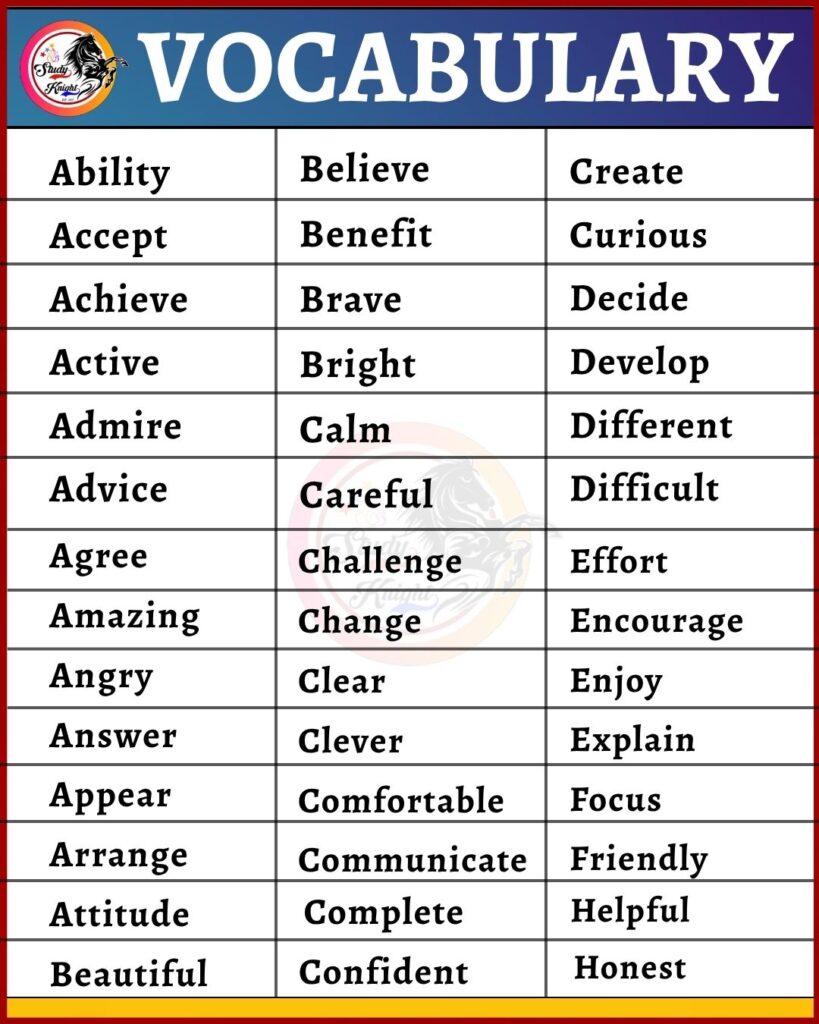
Vocabulary Examples (40 Words with Meanings and Sentences)
- Ability — क्षमता
Sentence: She has the ability to solve difficult problems. - Accept — स्वीकार करना
Sentence: He accepted the invitation happily. - Achieve — प्राप्त करना
Sentence: Hard work helps us achieve success. - Active — सक्रिय
Sentence: She is active in sports activities. - Admire — प्रशंसा करना
Sentence: I admire his honesty. - Advice — सलाह
Sentence: She gave me useful advice. - Agree — सहमत होना
Sentence: I agree with your opinion. - Amazing — अद्भुत
Sentence: The view from the hill was amazing. - Angry — क्रोधित
Sentence: He became angry over the mistake. - Answer — उत्तर
Sentence: She answered all questions correctly. - Appear — प्रकट होना
Sentence: A rainbow appeared after the rain. - Arrange — व्यवस्थित करना
Sentence: Please arrange the books properly. - Attitude — दृष्टिकोण
Sentence: A positive attitude leads to success. - Beautiful — सुंदर
Sentence: The garden looks beautiful today. - Believe — विश्वास करना
Sentence: I believe in hard work. - Benefit — लाभ
Sentence: Exercise has many health benefits. - Brave — बहादुर
Sentence: The brave firefighter saved lives. - Bright — उज्ज्वल
Sentence: She has a bright future. - Calm — शांत
Sentence: Stay calm during difficult situations. - Careful — सावधान
Sentence: Be careful while crossing the road. - Challenge — चुनौती
Sentence: Life gives us many challenges. - Change — बदलना
Sentence: Time can change everything. - Clear — स्पष्ट
Sentence: The instructions are clear. - Clever — चतुर
Sentence: He found a clever solution. - Comfortable — आरामदायक
Sentence: This chair is comfortable.
26–50
- Communicate — संवाद करना
Sentence: We communicate through language. - Complete — पूरा करना
Sentence: She completed her homework early. - Confident — आत्मविश्वासी
Sentence: He felt confident before speaking. - Create — बनाना
Sentence: Artists create wonderful paintings. - Curious — जिज्ञासु
Sentence: Children are curious by nature. - Decide — निर्णय लेना
Sentence: She decided to study harder. - Develop — विकसित करना
Sentence: Reading develops knowledge. - Different — अलग
Sentence: Everyone has different ideas. - Difficult — कठिन
Sentence: The exam was difficult. - Effort — प्रयास
Sentence: Success requires effort. - Encourage — प्रोत्साहित करना
Sentence: Teachers encourage students. - Enjoy — आनंद लेना
Sentence: I enjoy reading books. - Explain — समझाना
Sentence: The teacher explained the lesson. - Focus — ध्यान केंद्रित करना
Sentence: Students should focus on studies. - Friendly — मित्रवत
Sentence: The staff was friendly. - Helpful — सहायक
Sentence: She is always helpful. - Honest — ईमानदार
Sentence: An honest person is respected. - Improve — सुधार करना
Sentence: Practice improves skills. - Knowledge — ज्ञान
Sentence: Knowledge increases confidence. - Learn — सीखना
Sentence: We learn new things daily. - Manage — प्रबंधन करना
Sentence: He manages his time well. - Necessary — आवश्यक
Sentence: Water is necessary for life. - Opportunity — अवसर
Sentence: This job is a great opportunity. - Respect — सम्मान
Sentence: Always respect elders. - Success — सफलता
Sentence: Hard work brings success.
51–75
- Talent — प्रतिभा
Sentence: She has a talent for dancing. - Understand — समझना
Sentence: I understand the lesson now. - Valuable — मूल्यवान
Sentence: Time is valuable. - Wise — बुद्धिमान
Sentence: A wise person listens carefully. - Adapt — अनुकूल होना
Sentence: Humans adapt to change. - Accurate — सटीक
Sentence: The data is accurate. - Analyze — विश्लेषण करना
Sentence: Experts analyze situations deeply. - Appreciate — सराहना करना
Sentence: I appreciate your effort. - Approach — तरीका
Sentence: He used a smart approach. - Assist — सहायता करना
Sentence: Nurses assist doctors. - Attention — ध्यान
Sentence: Pay attention in class. - Attractive — आकर्षक
Sentence: The design is attractive. - Aware — जागरूक
Sentence: People are aware of health issues. - Balance — संतुलन
Sentence: Maintain balance in life. - Basic — मूलभूत
Sentence: These are basic rules. - Behavior — व्यवहार
Sentence: Good behavior matters. - Bold — साहसी
Sentence: She made a bold move. - Brief — संक्षिप्त
Sentence: Give a brief answer. - Career — करियर
Sentence: He plans his career carefully. - Celebrate — उत्सव मनाना
Sentence: They celebrate success together. - Character — चरित्र
Sentence: Character defines personality. - Choice — चयन
Sentence: Make the right choice. - Combine — मिलाना
Sentence: Combine both ideas. - Compare — तुलना करना
Sentence: Do not compare yourself. - Concern — चिंता
Sentence: Safety is our main concern.
76–100
- Consider — विचार करना
Sentence: Please consider my request. - Continue — जारी रखना
Sentence: She continued working. - Control — नियंत्रण
Sentence: Control your emotions. - Correct — सही
Sentence: Your answer is correct. - Courage — साहस
Sentence: Courage defeats fear. - Creative — रचनात्मक
Sentence: He has creative skills. - Culture — संस्कृति
Sentence: India has diverse culture. - Define — परिभाषित करना
Sentence: Define the term clearly. - Demand — मांग
Sentence: There is demand for teachers. - Depend — निर्भर होना
Sentence: Success depends on effort. - Describe — वर्णन करना
Sentence: Describe the picture. - Design — डिजाइन करना
Sentence: She designed a logo. - Detail — विवरण
Sentence: Explain in detail. - Discover — खोज करना
Sentence: Scientists discover new facts. - Discuss — चर्चा करना
Sentence: We discussed the topic. - Distance — दूरी
Sentence: The distance is short. - Dream — सपना
Sentence: Never give up your dream. - Duty — कर्तव्य
Sentence: It is our duty to help others. - Earn — कमाना
Sentence: He earns money honestly. - Educate — शिक्षित करना
Sentence: Schools educate children. - Effective — प्रभावी
Sentence: This method is effective. - Efficient — कुशल
Sentence: She is an efficient worker. - Emotion — भावना
Sentence: Music shows emotion. - Energy — ऊर्जा
Sentence: Exercise gives energy. - Equal — समान
Sentence: All people are equal.

101–125
- Escape — बच निकलना
Sentence: The bird escaped from the cage. - Establish — स्थापित करना
Sentence: They established a company. - Evaluate — मूल्यांकन करना
Sentence: Teachers evaluate performance. - Event — घटना
Sentence: The event was successful. - Example — उदाहरण
Sentence: This is a good example. - Excited — उत्साहित
Sentence: Children were excited. - Experience — अनुभव
Sentence: Experience improves skills. - Expert — विशेषज्ञ
Sentence: He is an expert teacher. - Express — व्यक्त करना
Sentence: Express your thoughts clearly. - Extend — बढ़ाना
Sentence: They extended the deadline. - Faith — विश्वास
Sentence: Keep faith in yourself. - Feature — विशेषता
Sentence: This phone has many features. - Flexible — लचीला
Sentence: Flexible plans help workers. - Freedom — स्वतंत्रता
Sentence: Freedom is precious. - Future — भविष्य
Sentence: Work hard for your future. - Gain — प्राप्त करना
Sentence: She gained experience. - Goal — लक्ष्य
Sentence: Set a clear goal. - Growth — विकास
Sentence: Reading supports growth. - Habit — आदत
Sentence: Wake up early as a habit. - Health — स्वास्थ्य
Sentence: Health is wealth. - Identify — पहचानना
Sentence: Identify the problem. - Include — शामिल करना
Sentence: Include all details. - Increase — बढ़ाना
Sentence: Prices increase yearly. - Influence — प्रभाव डालना
Sentence: Parents influence children. - Inform — जानकारी देना
Sentence: Please inform me early.
126–150
- Inspire — प्रेरित करना
Sentence: Teachers inspire students. - Interest — रुचि
Sentence: He has interest in music. - Journey — यात्रा
Sentence: Life is a long journey. - Justice — न्याय
Sentence: Everyone deserves justice. - Kindness — दयालुता
Sentence: Kindness spreads happiness. - Leadership — नेतृत्व
Sentence: Leadership requires confidence. - Logic — तर्क
Sentence: His answer followed logic. - Maintain — बनाए रखना
Sentence: Maintain discipline. - Motivate — प्रेरित करना
Sentence: Success stories motivate people. - Observe — अवलोकन करना
Sentence: Scientists observe nature. - Participate — भाग लेना
Sentence: Students participate actively. - Perform — प्रदर्शन करना
Sentence: She performed well. - Prepare — तैयारी करना
Sentence: Prepare for exams early. - Progress — प्रगति
Sentence: Hard work shows progress. - Protect — सुरक्षा करना
Sentence: Trees protect the environment. - Realize — महसूस करना
Sentence: He realized his mistake. - Reduce — कम करना
Sentence: Reduce plastic use. - Reflect — प्रतिबिंबित करना
Sentence: Actions reflect character. - Respond — उत्तर देना
Sentence: Please respond quickly. - Responsibility — जिम्मेदारी
Sentence: Responsibility builds maturity. - Select — चयन करना
Sentence: Select the correct option. - Support — समर्थन करना
Sentence: Parents support children. - Transform — बदलना
Sentence: Education transforms lives. - Trust — विश्वास करना
Sentence: Trust your abilities. - Value — महत्व देना
Sentence: We should value time.