

Sentences : Meaning, Structure & Types with Examples
In this English grammar lesson, we will understand what a sentence is and why it is essential for communication. Sentences allow us to express our thoughts 💭, feelings 😊, ideas 💡, and information clearly in both spoken and written English. When we learn how sentences are structured, it becomes easier to speak and write English effectively.
📘 Sentence क्या होता है?
जब हम बोलते 🗣️ या लिखते ✍️ हैं, तब हम शब्दों का प्रयोग करते हैं। आमतौर पर शब्द अकेले प्रयोग नहीं होते, बल्कि समूह में मिलकर एक पूरा अर्थ व्यक्त करते हैं। उदाहरण देखें —
✅ Birds fly. (पक्षी उड़ते हैं।)
✅ The sun rises in the east. (सूर्य पूर्व दिशा में उगता है।)
✅ Nehru was the first Prime Minister of India. (नेहरू भारत के प्रथम प्रधानमंत्री थे।)
✅ Farmers work hard in the fields. (किसान खेतों में मेहनत करते हैं।)
👉 परिभाषा:
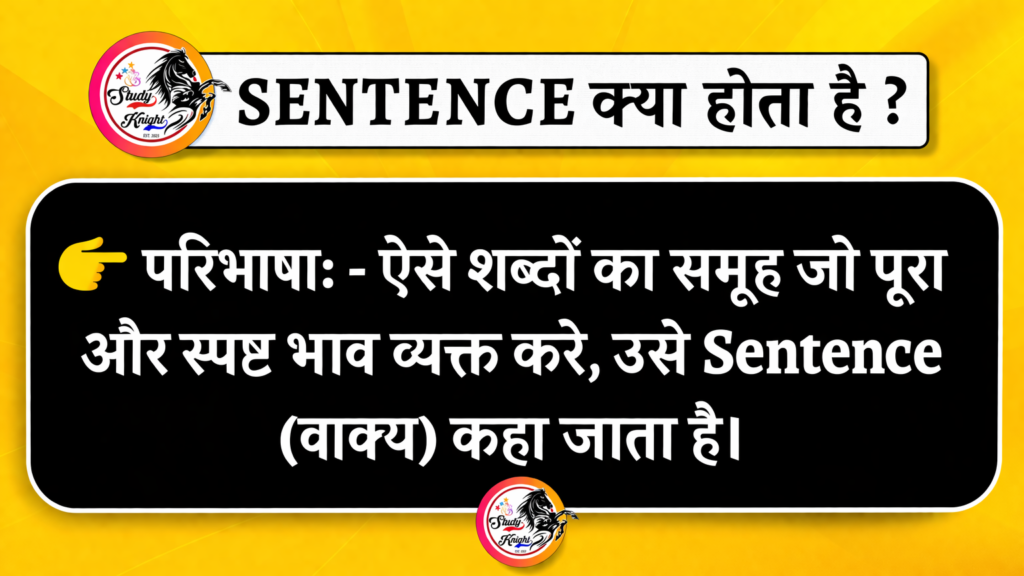
ऐसे शब्दों का समूह जो पूरा और स्पष्ट भाव व्यक्त करे, उसे Sentence (वाक्य) कहा जाता है।
📖 English Definition:
A sentence is a properly arranged group of words that expresses a complete thought or idea. It normally contains a subject and a predicate and conveys a meaningful message.
📌 Important Note:
🔠 अंग्रेजी में हर वाक्य का पहला शब्द हमेशा Capital Letter से शुरू होता है।
🧩 Basic Structure of a Sentence (वाक्य की मूल संरचना)
हर sentence मुख्य रूप से दो भागों से बना होता है:
👤 1. Subject (कर्ता)
Sentence का वह भाग जो बताता है कि बात किसके या किस चीज़ के बारे में हो रही है।
⚡ 2. Predicate (विधेय)
Sentence का वह भाग जो Subject के बारे में जानकारी देता है — वह क्या करता है या उसके साथ क्या होता है।
📝 Example:
Sentence: The boy plays football ⚽
- 👤 Subject: The boy
- ⚡ Predicate: plays football
यहाँ “The boy” वह व्यक्ति है जिसके बारे में बात हो रही है और “plays football” उसके कार्य को दर्शाता है।
✨ Types of Sentences in English Grammar (Kinds of Sentences)
📘 English Grammar में वाक्यों को अलग-अलग आधारों पर वर्गीकृत किया जाता है ताकि उनके प्रयोग और संरचना को आसानी से समझा जा सके। सामान्य रूप से sentences को दो मुख्य आधारों पर बाँटा जाता है:
👉 1. Usage (प्रयोग) के आधार पर
👉 2. Structure (बनावट) के आधार पर
🗣️ 1. Types of Sentences Based on Usage (प्रयोग के आधार पर)
प्रयोग के अनुसार वाक्य चार प्रमुख प्रकार के होते हैं:
✅ 1. Declarative / Assertive Sentence (वर्णनात्मक या कथनात्मक वाक्य)
ये वाक्य किसी तथ्य, विचार या जानकारी को सामान्य रूप से बताते हैं।
🔹 अंत में full stop (.) लगाया जाता है।
Examples:
- The earth moves around the sun. 🌍
- She enjoys reading books. 📚
❓ 2. Interrogative Sentence (प्रश्नवाचक वाक्य)
ऐसे वाक्य जिनका उपयोग प्रश्न पूछने के लिए किया जाता है।
🔹 अंत में question mark (?) आता है।
Examples:
- Where do you live? 🏠
- Are they coming today?
📝 3. Imperative Sentence (आज्ञा या अनुरोध सूचक वाक्य)
इन वाक्यों का प्रयोग आदेश, सलाह, अनुरोध या निर्देश देने के लिए किया जाता है।
🔹 अंत में full stop (.) या कभी-कभी exclamation mark (!) लगाया जाता है।
Examples:
- Close the door. 🚪
- Please help me with this task. 🙏
😲 4. Exclamatory Sentence (विस्मयादिबोधक वाक्य)
ये वाक्य तीव्र भावनाएँ जैसे खुशी, आश्चर्य, दुख या उत्साह व्यक्त करते हैं।
🔹 अंत में exclamation mark (!) लगाया जाता है।
Examples:
- What a beautiful view! 🌄
- How amazing this performance is! 🎉
🧩 2. Types of Sentences Based on Structure (बनावट के आधार पर)
Sentence की आंतरिक संरचना के अनुसार भी चार प्रकार होते हैं:
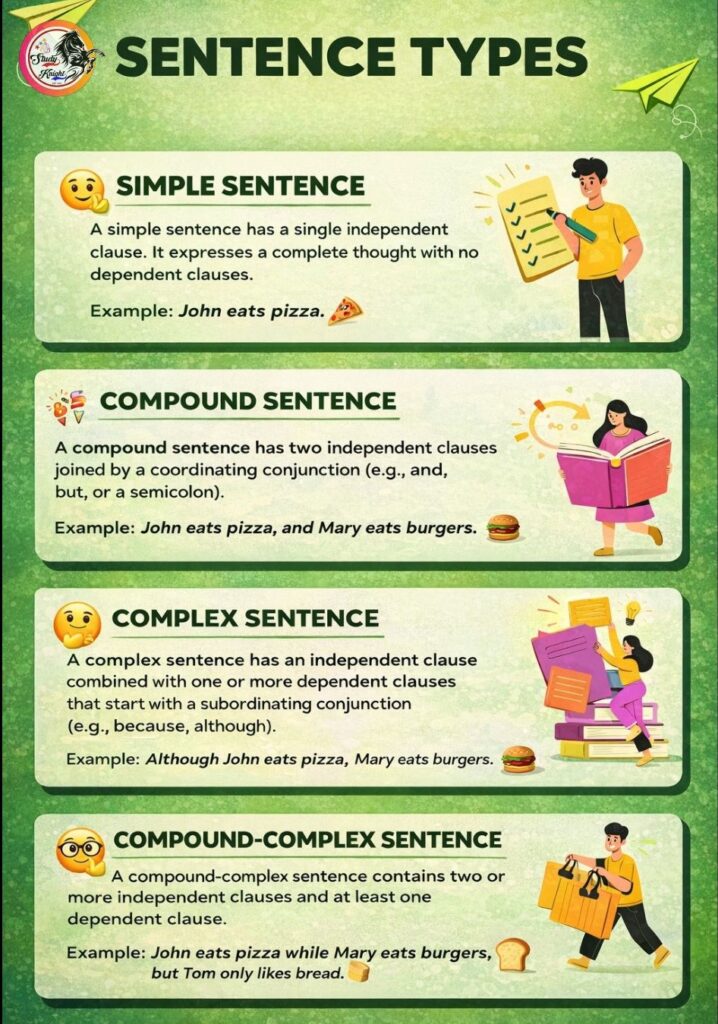
🔹 1. Simple Sentence (सरल वाक्य)
इसमें केवल एक independent clause होता है और यह एक पूर्ण विचार व्यक्त करता है।
Examples:
- The child laughed loudly. 😊
- Birds are singing. 🎶
🔹 2. Compound Sentence (संयुक्त वाक्य)
इसमें दो या अधिक independent clauses होते हैं, जिन्हें conjunctions (and, but, so, etc.) या semicolon से जोड़ा जाता है।
Examples:
- I finished my homework, and I went outside to play. ⚽
- He tried hard, but he missed the chance.
🔹 3. Complex Sentence (मिश्रित वाक्य)
इसमें एक main clause और कम से कम एक subordinate (dependent) clause होता है।
Examples:
- I will call you when I reach home. 📞
- She smiled because she was happy.
🔹 4. Compound-Complex Sentence
इस प्रकार के वाक्य में दो या अधिक independent clauses के साथ कम से कम एक dependent clause भी शामिल होता है।
Examples:
- I wanted to travel, but I stayed home because the weather was bad. 🌧️
- She completed the project, and everyone appreciated her when the results were announced.
🌟 Types of Sentences Based on Usage (प्रयोग के आधार पर वाक्यों के प्रकार)
अब हम sentences को उनके प्रयोग (Usage) के आधार पर विस्तार से समझेंगे। वाक्य का प्रकार इस बात पर निर्भर करता है कि वह सूचना दे रहा है, प्रश्न पूछ रहा है, आदेश दे रहा है या भावना व्यक्त कर रहा है।
Usage के आधार पर sentences चार प्रकार के होते हैं:
👉 Assertive sentences
👉 Interrogative sentences
👉 Imperative sentences
👉 Exclamatory sentences
✅ 1. Assertive Sentence (वर्णनात्मक / कथनात्मक वाक्य)
ऐसे वाक्य जिनसे किसी तथ्य, घटना या विचार की सामान्य जानकारी मिलती है, उन्हें Assertive Sentence कहा जाता है।
📌 इन वाक्यों के अंत में Full Stop (.) लगाया जाता है।
✨ Examples:
- Students must follow discipline. 🎓
- She completed her work on time. ⏰
- The old man was not afraid.
- Rohan could not attend the meeting.
👉 Assertive sentences दो प्रकार के होते हैं:
🟢 (A) Affirmative / Positive Sentence (स्वीकारात्मक वाक्य)
ये वाक्य किसी कार्य के होने या सत्य होने की सूचना देते हैं।
Examples:
- India hosted the event successfully. 🇮🇳
- The teacher explained the lesson clearly. 📘
- My brother plays cricket daily. 🏏
- Delhi is a historic city.
🔴 (B) Negative Sentence (नकारात्मक वाक्य)
इन वाक्यों में किसी कार्य के न होने या अस्वीकार का भाव होता है।
Examples:
- She does not like coffee. ☕
- They never miss their classes.
- I did not understand the question.
- The door was not open.
📍 Note: Assertive sentences हमेशा (.) से समाप्त होते हैं।
- What an exciting match! 🏆
- Oh, that is amazing!
📍 कभी-कभी इन वाक्यों में क्रिया स्पष्ट रूप से नहीं होती।
🧠 Test Yourself (अपनी समझ जांचें)
नीचे दिए गए वाक्यों का प्रकार पहचानिए:
- The sky is blue.
- Please sit down.
- Are you happy?
- Never lose hope.
- What a fantastic idea!
- Honesty is the best policy.
- Where did she go?
- Help the poor.
- How beautiful this place is!
- Knowledge is power.
✅ Answers:
- Assertive
- Imperative
- Interrogative
- Imperative
- Exclamatory
- Assertive
- Interrogative
- Imperative
- Exclamatory
- Assertive
➡️ अब आगे हम Structure (बनावट) के आधार पर sentences के प्रकार सीखेंगे। 📚✨
🧩 Types of Sentences Based on Structure (बनावट के आधार पर वाक्यों के प्रकार)
English Grammar में sentences को उनकी बनावट (Structure) तथा Clauses (उपवाक्यों) के आधार पर वर्गीकृत किया जाता है। यह वर्गीकरण इस बात पर निर्भर करता है कि वाक्य में कितनी clauses और verbs प्रयोग हुई हैं।
मुख्य रूप से sentences चार प्रकार के होते हैं:
👉 Simple Sentence (सरल वाक्य)
👉 Compound Sentence (संयुक्त वाक्य)
👉 Complex Sentence (मिश्रित वाक्य)
👉 Compound-Complex Sentence (संयुक्त-मिश्रित वाक्य)
🌿 1. Simple Sentence (सरल वाक्य)
Simple Sentence वह वाक्य होता है जिसमें केवल एक Finite Verb (मुख्य क्रिया) होती है और वह एक पूर्ण विचार व्यक्त करता है।
📌 चाहे verb एक शब्द की हो या कई शब्दों से बनी हो, यदि एक ही Finite Verb है तो वाक्य Simple कहलाता है।
✨ Examples:
- Sit down. 🪑
- She visited Jaipur last year.
- Rahul is writing a letter. ✍️
- The lesson is being explained by the teacher.
- He has been waiting since morning. ⏰
- I will have been studying for three hours.
👉 ऊपर दिए गए वाक्यों में verb अलग-अलग रूप में है, लेकिन प्रत्येक में केवल एक main finite verb group है।
📘 Finite Verb vs Non-Finite Verb
Finite Verb वह होती है जो subject और tense के अनुसार बदलती है।
लेकिन Non-Finite forms finite verb में शामिल नहीं होतीं।
🔹 Non-Finite Verb के प्रकार:
- Infinitive
- Participle
- Gerund
Examples:
- She came here to learn English. (to learn – Infinitive)
- Seeing the snake, he ran away. (Seeing – Participle) 🐍
- He was punished for breaking the rules. (breaking – Gerund)
🔗 2. Compound Sentence (संयुक्त वाक्य)
Compound Sentence वह वाक्य है जिसमें दो या दो से अधिक Independent Clauses होते हैं, जिन्हें coordinating conjunctions द्वारा जोड़ा जाता है।
👉 हर clause अपने आप में पूरा अर्थ देता है।
✨ Examples:
- Riya finished her work, and she went home. 🏠
- The sun was setting, but the children were still playing.
- He opened the door and entered the room.
📌 Compound sentence में clauses समान स्तर (equal importance) के होते हैं।
🔑 Common Coordinating Conjunctions
इन conjunctions का प्रयोग compound sentences बनाने में किया जाता है:
👉 and
👉 but
👉 or
👉 so
👉 yet
👉 for
👉 nor
👉 either…or
👉 neither…nor
👉 otherwise
👉 still
👉 else
📝 Examples with Conjunctions
- She studied hard, so she passed the exam. 🎓
- Hurry up, or you will miss the bus. 🚌
- He is rich, yet he lives simply.
- Either you call him or send a message.
- They were tired, but they continued working.
- Walk fast, otherwise you will be late.
- He neither apologized nor explained his mistake.
📍 Important Point:
Compound sentence बनने के लिए कम से कम दो independent clauses होना आवश्यक है।
🌳 3. Complex Sentence (मिश्रित वाक्य)
Complex Sentence में:
✅ एक Main Clause (Principal Clause)
✅ कम से कम एक Subordinate Clause (Dependent Clause)
होती है।
Dependent clause अकेले पूर्ण अर्थ नहीं देती।
✨ Examples:
- I will help you when you need me. 🤝
- She stayed at home because she was ill.
- The boy who won the race is my friend. 🏃
👉 Subordinate clause main clause पर निर्भर रहती है।
🔄 4. Compound-Complex Sentence
इस प्रकार के sentence में:
✅ दो या अधिक Independent Clauses
✅ कम से कम एक Dependent Clause
दोनों शामिल होते हैं।
✨ Examples:
- I wanted to travel, but I stayed home because it was raining. 🌧️
- She completed the task, and everyone praised her when the results were declared.
✅ Quick Summary Table
| Type | Clauses | Main Idea |
| Simple | 1 Independent | Single idea |
| Compound | 2+ Independent | Equal ideas |
| Complex | 1 Independent + 1 Dependent | One depends on another |
| Compound-Complex | Multiple + Dependent | Mixed structure |
🌳 Complex Sentence (मिश्रित वाक्य)
Complex Sentence वह वाक्य होता है जिसमें:
✅ केवल एक Principal Clause (मुख्य उपवाक्य) होता है
✅ और उसके साथ कम से कम एक Subordinate Clause (आश्रित उपवाक्य) जुड़ी होती है।
Subordinate clause अपने आप पूर्ण अर्थ नहीं देती; उसका अर्थ मुख्य clause पर निर्भर करता है।
✨ Examples:
1️⃣ Ramesh said that he would visit Delhi.
2️⃣ I met a girl who teaches mathematics.
3️⃣ When the bell rang, the teacher who was in the classroom announced that the test would begin.
🔎 Clause Analysis (उपवाक्य की पहचान)
✅ Example 1:
Ramesh said that he would visit Delhi.
- 🟢 Principal Clause: Ramesh said
- 🔵 Subordinate Clause: that he would visit Delhi
✅ Example 2:
I met a girl who teaches mathematics.
- 🟢 Principal Clause: I met a girl
- 🔵 Subordinate Clause: who teaches mathematics
✅ Example 3:
When the bell rang, the teacher who was in the classroom announced that the test would begin.
- 🟢 Principal Clause: the teacher announced
- 🔵 Subordinate Clauses:
- When the bell rang → Adverb Clause ⏰
- who was in the classroom → Adjective Clause 👩🏫
- that the test would begin → Noun Clause 📘
📚 Types of Subordinate Clauses in Complex Sentences
🕒 1. Adverb Clause
समय, कारण, शर्त या परिस्थिति बताती है।
👉 Example:
- When the rain stopped, we went outside.
🧑 2. Adjective Clause
किसी noun या pronoun के बारे में अतिरिक्त जानकारी देती है।
👉 Example:
- The boy who won the prize is my cousin.
💡 3. Noun Clause
Sentence में noun की तरह कार्य करती है।
👉 Example:
- I believe that honesty is important.
📌 Important Note
⭐ Complex Sentence की पहचान यह है कि:
- इसमें केवल एक Principal Clause होती है।
- बाकी सभी clauses Subordinate Clauses होती हैं।
- Subordinate clauses की संख्या एक या अधिक हो सकती है — इससे sentence का प्रकार नहीं बदलता।
🔄 Compound-Complex Sentence (संयुक्त-मिश्रित वाक्य)
Compound-Complex Sentence वह वाक्य होता है जिसमें:
✅ दो या दो से अधिक Independent Clauses (स्वतंत्र उपवाक्य) होते हैं
✅ और साथ में कम से कम एक Dependent / Subordinate Clause (आश्रित उपवाक्य) भी होती है।
इस प्रकार का sentence compound और complex दोनों की विशेषताओं को एक साथ मिलाता है, इसलिए इसका structure थोड़ा विस्तृत और अर्थ अधिक स्पष्ट होता है।
🧩 Main Components of a Compound-Complex Sentence
🟢 Independent Clauses
ये ऐसे clauses होते हैं जो अपने आप में पूरा अर्थ देते हैं और अलग sentence की तरह भी लिखे जा सकते हैं।
👉 Example idea:
- She completed the project.
- Everyone appreciated her.
दोनों अलग-अलग भी meaningful हैं।
🔵 Dependent (Subordinate) Clause
यह clause अकेले पूरा अर्थ नहीं देती और main clause पर निर्भर रहती है।
👉 Example idea:
- because she worked hard
यह अकेले sentence नहीं बन सकता।
💡 Why Use Compound-Complex Sentences?
✨ इनका उपयोग तब किया जाता है जब हमें:
- कई विचारों को एक साथ जोड़ना हो
- कारण, समय या परिस्थिति बतानी हो
- अधिक detailed और natural expression देना हो
📝 Example of Compound-Complex Sentence
Sentence:
Although the weather was cold, Rahul went for a walk, and his friends stayed indoors to watch a movie. 🎬❄️
🔍 Clause Breakdown:
- 🔵 Dependent Clause:
Although the weather was cold - 🟢 Independent Clause 1:
Rahul went for a walk - 🟢 Independent Clause 2:
his friends stayed indoors to watch a movie
📌 Easy Identification Tip: (Sentences)
अगर किसी sentence में
✔ multiple complete ideas (independent clauses)
✔ और एक dependent clause
दोनों मौजूद हों → वह Compound-Complex Sentence होता है।
🔗 Compound Sentence बनाना (Formation of Compound Sentences)
Compound Sentence बनाने के लिए दो या अधिक Independent Sentences को सही Coordinating Conjunction (and, but, or, so, yet, nor, etc.) की सहायता से जोड़ा जाता है।
📘 नीचे दिए गए वाक्यों को उचित conjunction लगाकर Compound Sentence में बदला गया है।
✨ Exercise 1: Join the Sentences Using Suitable Conjunctions
📝 Given Sentences → Compound Sentence
1️⃣ The phone kept ringing. Nobody answered it.
👉 The phone kept ringing, but nobody answered it. ☎️
2️⃣ He became an orphan at a young age. His aunt raised him.
👉 He became an orphan early, but his aunt raised him.
3️⃣ She scored excellent marks. She topped the district.
👉 She scored excellent marks, and she topped the district. 🏆
4️⃣ He hardly studied. He still cleared the exam.
👉 He hardly studied, yet he cleared the exam.
5️⃣ His family is out of town. He eats at restaurants.
👉 His family is out of town, so he eats at restaurants. 🍽️
6️⃣ People come and people leave. Life continues forever.
👉 People come and people leave, but life continues forever.
7️⃣ You may travel by air. You may travel by train.
👉 You may travel by air or you may travel by train. ✈️🚆
8️⃣ He neither visited me. He sent no message.
👉 He neither visited me, nor did he send any message.
9️⃣ Invite her personally. She will not attend.
👉 Invite her personally, otherwise she will not attend.
🔟 We bought nothing. All stores were shut.
👉 We bought nothing, for all stores were shut.
🧩 Exercise 2: Complete the Sentence Using Given Conjunctions
( and, as well as, or, nor, but, yet )
✅ Completed Sentences
1️⃣ The doctor tried everything to save the patient, but he failed. 🏥
2️⃣ My cousin is neither lazy nor careless.
3️⃣ The archer aimed carefully, yet he missed the shot. 🎯
4️⃣ The burglar entered the house and stole jewellery.
5️⃣ Your daughter excels in science as well as mathematics.
6️⃣ He will arrive either tonight or tomorrow morning.
7️⃣ Anita speaks Hindi fluently and understands Spanish too.
8️⃣ I worked continuously, yet I couldn’t finish the assignment.
9️⃣ My assistant is honest and dependable.
🔟 Hurry up or you will miss the bus. 🚌
🚀 Exercise 3: Add a Clause Using Suitable Conjunction
(and, so, or, nor, but, yet)
✅ Completed Compound Sentences
1️⃣ I ran quickly, but I missed the train. 🏃
2️⃣ Sit here, so we can talk peacefully.
3️⃣ The horse is old, yet it runs strongly. 🐎
4️⃣ Move fast or you will be late.
5️⃣ He tried sincerely, but he failed to win.
6️⃣ Be kind and everyone will respect you. 😊
7️⃣ He neither returned the money nor gave any explanation.
8️⃣ She completed her task, so she relaxed afterward.
9️⃣ He must leave early or he will miss the meeting.
🔟 He is poor, yet he helps others generously.
1️⃣1️⃣ Keep silent or you will disturb the class. 🤫
1️⃣2️⃣ He did no work, nor did he show responsibility.
📌 Quick Learning Tip
👉 Compound Sentence पहचानने का आसान तरीका:
✅ दो complete ideas हों
✅ दोनों clauses बराबर importance की हों
✅ conjunction से जुड़े हों
➡️ तब वह Compound Sentence होता है।
🌳 COMPLEX SENTENCE बनाना (Formation of Complex Sentences)
Complex Sentence बनाने के लिए मुख्य रूप से Subordinate Clauses का प्रयोग किया जाता है। ये clauses मुख्य वाक्य (Principal Clause) पर निर्भर होती हैं।
Complex Sentence बनाने में तीन प्रकार की clauses महत्वपूर्ण होती हैं:
👉 Noun Clause
👉 Adjective Clause
👉 Adverb Clause
(Sentence)इस भाग में हम Noun Clause का प्रयोग सीखेंगे। 📘
🧠 Use of Noun Clause (Noun Clause का प्रयोग)
Noun Clause sentence में noun की तरह कार्य करती है। यह Subject, Object, Complement या Preposition के Object के रूप में आ सकती है।
📌 Basic Structure:
Independent Clause + Subordinating Word + Noun Clause
(Subordinating words: that, what, where, why, how, when, who, etc.)
✨Examples with Explanation (Sentence)
✅Example 1 (Sentences)
She told me that the meeting was postponed.
- 🟢 Principal Clause: She told me
- 🔵 Noun Clause: that the meeting was postponed
👉 यहाँ noun clause verb told का object है।
✅Example 2 (Sentences)
I forgot where I kept my keys. 🔑
- 🟢 Principal Clause: I forgot
- 🔵 Noun Clause: where I kept my keys
👉 यह clause verb forgot का object बन रही है।
✅Example 3 (Sentences)
That is how he solved the problem.
👉 “how he solved the problem” verb is का complement है।
✅Example 4 (Sentences)
Do not believe what strangers say.
👉 “what strangers say” preposition/verb का object है।
✅Example 5 (Sentence)
Why she resigned surprised everyone. 😮
- 🟢 Principal Clause: surprised everyone
- 🔵 Noun Clause: Why she resigned
👉 यहाँ noun clause sentence का subject है।
✅Example 6 (Sentences)
The news that the team won the final turned out to be false.
👉 “that the team won the final” noun news की अतिरिक्त जानकारी देता है (apposition).
✅Example 7 (Sentence)
I am sure that he will help us.
👉 Noun clause adjective sure को complete कर रही है।
📘 Practice Exercise – Add a Suitable Noun Clause
नीचे दिए गए वाक्यों को that / who / what / when / where / why / how से शुरू होने वाली noun clause जोड़कर पूरा करें।
1️⃣ He does not understand __________.
2️⃣ It was shocking __________.
3️⃣ We cannot depend on __________.
4️⃣ __________ amazed everyone present.
5️⃣ The teacher asked me __________.
6️⃣ It is certain __________.
7️⃣ We discovered __________.
8️⃣ Do you know __________?
9️⃣ __________ is still unknown.
🔟 She believes __________.
1️⃣1️⃣ Nobody knows __________.
1️⃣2️⃣ Tell me __________.
✅ Possible Answers
1️⃣ He does not understand why they refused.
2️⃣ It was shocking what happened yesterday.
3️⃣ We cannot depend on what he promises.
4️⃣ How he solved the puzzle amazed everyone present. 🧩
5️⃣ The teacher asked me where I had been.
6️⃣ It is certain that success requires effort.
7️⃣ We discovered where the documents were hidden.
8️⃣ Do you know how this machine works?
9️⃣ When the results will be announced is still unknown.
🔟 She believes that honesty brings respect.
1️⃣1️⃣ Nobody knows what lies ahead.
1️⃣2️⃣ Tell me when you will return.
🌿Use of Adjective Clauses (Restrictive Clause – Sentences)
(Adjective Clause / Relative Clause का प्रयोग)
Adjective Clause वह clause होती है जो किसी noun या pronoun के बारे में अतिरिक्त जानकारी देती है। यह adjective की तरह काम करती है, इसलिए इसे Adjective Clause कहा जाता है।
📘 इसे Relative Clause भी कहा जाता है।
🔗 Adjective Clause कैसे बनती है?
Adjective Clause सामान्यतः Relative Pronouns और Relative Adverbs से शुरू होती है।
✅ Common Relative Words:
👉 who
👉 whom
👉 whose
👉 that
👉 which
👉 when
👉 where
👉 why
👉 as
📌 इन शब्दों से पहले हमेशा एक noun आता है जिसे Antecedent (पूर्ववर्ती) कहा जाता है।
🎯 Restrictive Clause (सीमित अर्थ वाली Clause)
Restrictive Adjective Clause noun की पहचान को सीमित या स्पष्ट करती है।
यदि clause हटा दी जाए तो sentence का अर्थ अधूरा या अस्पष्ट हो जाता है।
👉 इसलिए इसका प्रयोग Restrictive Sense में किया जाता है, न कि Continuative (extra information) sense में।
✨ Examples with Explanation
1️⃣ The book that you recommended is very useful. 📚
👉 “that you recommended” book के बारे में आवश्यक जानकारी दे रही है।
2️⃣ The train which is coming now goes to Jaipur. 🚆
3️⃣ We visited the house where the poet lived. 🏠
4️⃣ The car that dropped me here has already left.
5️⃣ Do you know the day when the results will be declared?
6️⃣ Nobody understands the reason why she resigned.
⭐Use of “AS” in Adjective Clause (Sentences)
जब as का प्रयोग Adjective Clause में होता है, तब उससे पहले अक्सर such या same आता है।
Examples:
- I dislike such people as waste time.
- This is the same dress as I wanted to buy. 👗
📌 Important Note
✔ Adjective Clause = Relative Clause
✔ इसमें Relative Pronoun/Adverb noun को describe करता है।
🔍 Restrictive vs Continuative (Difference)
✅ Restrictive Clause → Complex Sentence
He is the player who scored the winning goal.
👉 Clause आवश्यक जानकारी दे रही है।
✅ Continuative Sense → Compound Meaning
I met Ravi, who helped me yesterday.
👉 यहाँ clause अतिरिक्त जानकारी दे रही है (comma के बाद)।
Meaning ≈
I met Ravi and he helped me yesterday.
📝 Practice Exercise – Fill in the blanks
( who, whose, whom, which, that )
1️⃣ The man ______ was arrested yesterday is innocent.
2️⃣ I met Mr. Sharma ______ son is a doctor.
3️⃣ She is the only person ______ I trust completely.
4️⃣ The author ______ books inspire me is Tagore.
5️⃣ Bring the files ______ require signatures.
6️⃣ Can you identify the boy ______ broke the glass?
7️⃣ I dislike people ______ speak rudely.
8️⃣ The dog ______ chased the child was aggressive.
9️⃣ Give me the tools ______ are kept on the table.
🔟 Is this the painting ______ you wanted?
✅ Answers
1️⃣ who
2️⃣ whose
3️⃣ whom / that
4️⃣ whose
5️⃣ that / which
6️⃣ who / that
7️⃣ who / that
8️⃣ that / which
9️⃣ that / which
🔟 that / which
📌 Quick Exam Trick 🧠 (Sentences)
👉 अगर clause किसी noun की पहचान बता रही हो → Adjective Clause
👉 Relative word (who/which/that…) दिखे → तुरंत पहचानें ✔
🔗 Joining Two Sentences to Form a Complex Sentence
(Relative Pronoun & Relative Adverb का प्रयोग)
Relative Pronouns और Relative Adverbs की सहायता से दो Simple Sentences को जोड़कर एक Complex Sentence बनाया जा सकता है।
इस प्रक्रिया में दूसरा वाक्य पहले वाक्य के noun के बारे में अतिरिक्त जानकारी देता है और Adjective Clause बन जाती है।
🧩Basic Idea (Sentence)
👉 Sentence 1 → मुख्य जानकारी देता है
👉 Sentence 2 → noun के बारे में extra information देता है
दोनों को Relative word (who, which, that, where, when आदि) से जोड़ दिया जाता है।
✨ Example
Simple Sentences:
- Sita travelled to Mumbai by bus.
- The bus broke down on the way.
✅ Combined Complex Sentence:
The bus by which Sita travelled to Mumbai broke down on the way. 🚌
👉 Highlighted part = Adjective Clause
📌 Omission of Relative Pronoun (Relative Pronoun हटाना)
जब Relative Pronoun clause में object के रूप में आता है, तो उसे अक्सर हटाया जा सकता है।
Examples:
- The pen (that) you gave me writes smoothly. ✍️
- The movie (which) we watched was exciting. 🎬
- This is the person (whom) you wanted to meet.
👉 Meaning same रहता है, pronoun optional हो जाता है।
🔄 Relative Pronoun + Preposition Rule
यदि Relative Pronoun किसी preposition का object हो, तो pronoun हटाने पर preposition clause के अंत में चली जाती है।
Examples:
1️⃣ The student to whom I gave notes is absent.
➡ The student I gave notes to is absent.
2️⃣ The friend on whom she relied disappointed her.
➡ The friend she relied on disappointed her.
3️⃣ The method by which he solved the puzzle is unique.
➡ The method he solved the puzzle by is unique.
📝 Practice Exercise
Join the following Simple Sentences into one Complex Sentence using an Adjective Clause:
1️⃣ A woman painted this picture. She will visit us today.
2️⃣ You borrowed a pen from me. Have you returned it?
3️⃣ We live in a town. It lacks proper hospitals.
4️⃣ This is the house. I spent my childhood in it.
5️⃣ Several passengers were hurt in the crash. They are recovering now.
6️⃣ A girl danced beautifully. She received first prize.
7️⃣ He delivered a lecture. He had prepared it carefully.
8️⃣ He worked in an office. It was a reputed company.
9️⃣ We purchased a laptop. It stopped working soon.
🔟 Buddha meditated under a tree. The tree is famous today.
✅ Possible Answers (Complex Sentences)
1️⃣ A woman who painted this picture will visit us today. 🎨
2️⃣ Have you returned the pen that you borrowed from me?
3️⃣ We live in a town that lacks proper hospitals.
4️⃣ This is the house in which I spent my childhood. 🏠
5️⃣ The passengers who were hurt in the crash are recovering now.
6️⃣ The girl who danced beautifully received first prize. 🏆
7️⃣ He delivered a lecture that he had prepared carefully.
8️⃣ He worked in an office which was a reputed company.
9️⃣ We purchased a laptop that stopped working soon. 💻
🔟 Buddha meditated under a tree which is known as the Bodhi tree. 🌳
📌 Quick Exam Tip 🧠 (Sentences)
✔ Two simple sentences + Relative word
➡ बन जाता है Complex Sentence (Adjective Clause)
🌦️ Use of Adverb Clause (Adverbial Clause का प्रयोग)
Complex Sentence बनाने में Adverb Clause का महत्वपूर्ण योगदान होता है।
Adverb Clause verb, adjective या पूरे sentence के बारे में अतिरिक्त जानकारी देती है — जैसे समय, कारण, शर्त, उद्देश्य, तुलना, परिणाम आदि।
👉 सरल शब्दों में:
Adverb Clause बताती है — कब? क्यों? कैसे? कहाँ? किस शर्त पर?
🔗 Common Subordinating Conjunctions
Adverb Clause बनाने के लिए निम्न conjunctions का प्रयोग किया जाता है:
✨ that, if, when, where, why, because, than, till, until, unless, though, although, after, before, while, since, lest, as soon as, as long as, so long as, in case, even if आदि।
🧠 Examples of Adverb Clauses
- I will call you when I reach home. 📞 (Time)
- She stayed inside because it was raining. 🌧️ (Reason)
- Work hard so that you may succeed. 🎯 (Purpose)
- He runs faster than I do. (Comparison)
📝 Exercise – Fill in the blanks
Choose the correct option from the brackets.
1️⃣ The train had already left ______ I reached the station.
(after, since, before)
✅ Answer: before
👉 The train had already left before I reached the station.
2️⃣ We could not attempt every question ______ there was limited time.
(as long as, although, because)
✅ Answer: because
👉 We could not attempt every question because there was limited time.
3️⃣ Industries should be developed in villages ______ cities do not become overcrowded.
(because, so that, as soon as)
✅ Answer: so that
👉 Industries should be developed in villages so that cities do not become overcrowded.
4️⃣ Write down my phone number ______ you forget it later.
(as, because, lest)
✅ Answer: lest
👉 Write down my phone number lest you forget it later. 📒
5️⃣ ______ it was getting dark, we decided to hire a taxi.
(since, when, though)
✅ Answer: since
👉 Since it was getting dark, we decided to hire a taxi.
6️⃣ ______ the teacher entered the classroom, the students became silent.
(as long as, as soon as, before)
✅ Answer: as soon as
👉 As soon as the teacher entered the classroom, the students became silent. 🤫
7️⃣ ______ we had watched the movie earlier, we wanted to see it again.
(because, as, although)
✅ Answer: although
👉 Although we had watched the movie earlier, we wanted to see it again. 🎬
8️⃣ He appears younger ______ he actually is.
(than, then, as)
✅ Answer: than
👉 He appears younger than he actually is.
9️⃣ Plants respire ______ animals do.
(because, so, as)
✅ Answer: as
👉 Plants respire as animals do. 🌱
🔟 I have not received any message from him ______ he moved away.
(as, since, after)
✅ Answer: since
👉 I have not received any message from him since he moved away.
1️⃣1️⃣ He discontinued his studies ______ his father passed away.
(before, after, till)
✅ Answer: after
👉 He discontinued his studies after his father passed away.
1️⃣2️⃣ He had stopped studying ______ his father passed away.
(before, after, till)
✅ Answer: before
👉 He had stopped studying before his father passed away.
📌Quick Exam Trick 🧠 (Sentences)
| Clause Type | Common Words |
| Time ⏰ | when, before, after, since |
| Cause 💡 | because, since, as |
| Purpose 🎯 | so that, lest |
| Condition ⚖️ | if, unless |
| Contrast 🔄 | although, though |
| Comparison 📊 | than, as |
👉 Sentence में conjunction देखकर Adverb Clause आसानी से पहचानी जा सकती है।
🔗 Joining Two Sentences to Form a Complex Sentence Using Adverb Clause
Adverb Clause की सहायता से दो अलग-अलग sentences को जोड़कर एक Complex Sentence बनाया जा सकता है।
इसमें मुख्य वाक्य (Principal Clause) के साथ एक Adverb Clause जुड़ती है, जो कारण, शर्त, समय या परिणाम बताती है।
👉 Complex Sentence बनाने के लिए Subordinating Conjunctions का प्रयोग किया जाता है।
⚖️ Adverb Clause of Condition (शर्त बताने वाली Clause)
Condition बताने के लिए सामान्यतः इन conjunctions का प्रयोग होता है:
✅ if
✅ unless
✅ in case
ये शब्द बताते हैं कि कोई कार्य किस शर्त पर होगा।
📝 Exercise — Combine the Sentences
(Use the conjunction given in brackets)
1️⃣
I worked hard. I passed the examination. (as)
✅ As I worked hard, I passed the examination. 🎓
2️⃣
You stop smoking. You can get rid of the cough. (if)
✅ If you stop smoking, you can get rid of the cough.
3️⃣
He did not ask for dowry. The girl agreed to marry him. (as)
✅ As he did not ask for dowry, the girl agreed to marry him.
4️⃣
There was no doctor nearby. The injured man could not be saved. (as)
✅ As there was no doctor nearby, the injured man could not be saved.
5️⃣
Pull the emergency chain. The train will stop. (if)
✅ If you pull the emergency chain, the train will stop. 🚆
6️⃣
He drove very fast. He lost control of the car. (if)
✅ If he drives very fast, he loses control of the car.
7️⃣
He did not study seriously. He failed the exam. (as)
✅ As he did not study seriously, he failed the exam.
8️⃣
Do not give advice to people. They ask for it. (unless)
✅ Unless people ask for it, do not give advice.
9️⃣
He must be disciplined. Otherwise he will not improve. (unless)
✅ Unless he is disciplined, he will not improve.
📌 Quick Rule 🧠
👉 If / Unless = Condition (शर्त)
👉 As / Because = Reason (कारण)
Structure:
Subordinating Conjunction + Clause + Main Clause
📘 Learn Again: Parts of a Sentence
हर sentence दो मुख्य भागों से मिलकर बनता है:
✅ Subject → जिसके बारे में बात हो रही है
✅ Predicate → Subject क्या करता है या उसके साथ क्या होता है
✨ Example:
The cat slept on the sofa. 🐱
- Subject → The cat
- Predicate → slept on the sofa
❓ FAQs (Frequently Asked Questions)
⭐ What is the basic structure of a sentence?
A sentence normally contains two parts:
- Subject (the doer or topic)
- Predicate (action or information about the subject)
Example:
👉 The bird is flying.
Subject = The bird | Predicate = is flying
⭐ How can we identify different types of sentences?
Sentence का प्रकार उसके purpose और punctuation से पहचाना जाता है:
✅ Declarative Sentence – statement देता है (.)
She enjoys music.
✅ Interrogative Sentence – प्रश्न पूछता है (?)
Are you ready?
✅ Imperative Sentence – आदेश या अनुरोध देता है (./!)
Close the window.
✅ Exclamatory Sentence – भावना व्यक्त करता है (!)
What a wonderful surprise! 🎉