

Narration in English Grammar: Direct & Indirect Speech (Hindi Explanation:Narration)
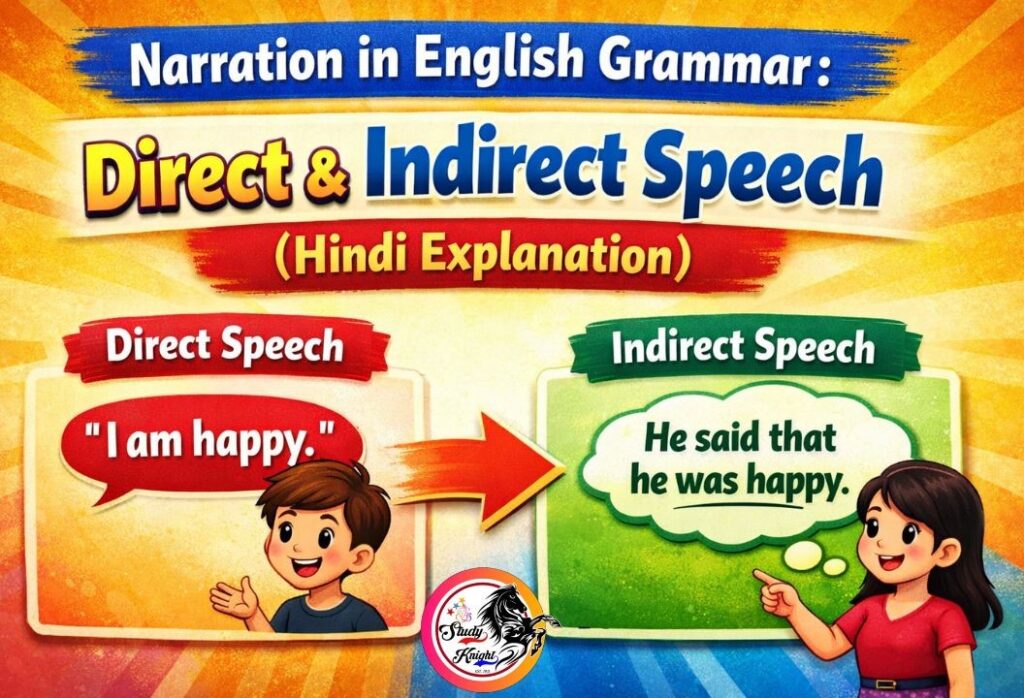
🗣️Narration क्या है? (Direct & Indirect Speech आसान भाषा में)
English Grammar में Narration का मतलब है — किसी व्यक्ति द्वारा कही गई बात को दूसरे व्यक्ति तक सही तरीके से पहुँचाना।
किसी के शब्दों को बताने के मुख्य रूप से दो तरीके होते हैं:
👉 Direct Speech (प्रत्यक्ष कथन)
👉 Indirect Speech (अप्रत्यक्ष कथन)
आइए दोनों को आसान उदाहरणों के साथ समझते हैं।
📌 1. Direct Speech (प्रत्यक्ष कथन)
जब हम किसी व्यक्ति की कही हुई बात को बिल्कुल उसी रूप में लिखते हैं और उसे quotation marks (“ ”) के अंदर रखते हैं, तो उसे Direct Speech कहा जाता है।
👉 यानी बोलने वाले के शब्दों में कोई बदलाव नहीं किया जाता।
✅ Examples:
- Mohan said, “I am feeling happy.”
- Teacher said, “Complete your homework today.”
यहाँ sentences में speaker के exact words लिखे गए हैं।
📌 2. Indirect Speech (अप्रत्यक्ष कथन)
जब हम किसी की बात को अपने शब्दों में बताते हैं और quotation marks का प्रयोग नहीं करते, तो उसे Indirect Speech कहते हैं।
👉 इसमें sentence की structure, pronoun और tense बदल सकते हैं।
✅ Examples:
- Mohan said that he was feeling happy.
- The teacher instructed the students to complete their homework that day.
यहाँ original words को बदलकर meaning same रखा गया है।
🔄 Direct से Indirect Speech कैसे बनती है?
एक example से समझते हैं 👇
👉 Direct Speech:
Rohit says, “Ankit will start a new course.”
❓ Question: What does Rohit say?
✅ Indirect Speech:
Rohit says that Ankit will start a new course.
यहाँ quotation marks हटाकर sentence को report किया गया है।
🗨️ Narration के प्रकार और Direct से Indirect Speech के महत्वपूर्ण नियम
अब तक हमने समझ लिया कि Speaker (वक्ता) की कही हुई बात को अलग-अलग तरीकों से व्यक्त किया जा सकता है। English Grammar में इसे Narration कहा जाता है। आइए इसे आसान तरीके से समझते हैं 👇
📖 Speaker की बात बताने के दो तरीके
किसी के कथन को सामान्यतः दो रूपों में लिखा या बोला जाता है:
👉 Direct Speech (Direct Narration)
👉 Indirect Speech (Indirect Narration)
✅ Example:
Direct Speech:
Ramesh says, “Vijay will purchase a bike.”
Indirect Speech:
Ramesh says that Vijay will purchase a bike.
यहाँ दूसरा वाक्य speaker की बात को अपने शब्दों में बताता है।
✨Direct Speech क्या होती है? (Narration)
Direct Speech में speaker के exact words quotation marks (“ ”) के अंदर लिखे जाते हैं। इसमें कथन जैसा बोला गया है वैसा ही रहता है।
🔄 Direct Speech को Indirect Speech में बदलने के Rules
अब हम step-by-step महत्वपूर्ण नियम समझते हैं 📚
✅ Rule 1: Inverted Commas का प्रयोग
👉 Direct Speech में Inverted Commas (“ ”) का उपयोग होता है।
👉 Indirect Speech में quotation marks हटा दिए जाते हैं।
Example:
Direct:
He says to his brother, “I am preparing for exams.”
Indirect:
He tells his brother that he is preparing for exams.
🔎 यहाँ:
- He → Speaker
- says → Reporting Verb
- Commas के अंदर का भाग → Reported Clause (Speaker का कथन)
Modern grammar में इसे Reported Clause कहा जाता है।
✅ Rule 2: ‘That’ का प्रयोग (Assertive Sentences)
जब sentence एक सामान्य कथन (Assertive Sentence) होता है, तो Reporting Verb के बाद अक्सर “that” लगाया जाता है।
✔ यदि said के बाद object नहीं हो → said ही रहेगा
✔ यदि said to + object हो → told + object बन जाता है
Example:
- She said, “I like reading.”
→ She said that she liked reading. - She said to me, “I like reading.”
→ She told me that she liked reading.
✅ Rule 3: Tense Change का नियम
Reporting Verb का tense बहुत महत्वपूर्ण होता है 👇
👉 यदि Reporting Verb Present या Future Tense में है → tense नहीं बदलता।
👉 यदि Reporting Verb Past Tense में है → tense बदल जाता है।
Quick Guide:
| Direct Speech | Indirect Speech |
| says | says |
| will say | will say |
| said | said |
| said to + object | told + object |
⭐ आसान टिप्स याद रखने के लिए
✔ Direct Speech = quotation marks ✅
✔ Indirect Speech = no quotation marks ❌
✔ Assertive sentence में “that” आता है
✔ Past reporting verb होने पर tense change होता है
⏳ Direct से Indirect Speech में Tense Change के Rules (Easy Guide)
Narration बदलते समय सबसे महत्वपूर्ण हिस्सा होता है Tense का परिवर्तन। जब Direct Speech को Indirect Speech में बदला जाता है, तो verb का tense अक्सर बदल जाता है। नीचे इसे आसान तरीके से समझाया गया है 👇
🔄 Tense Change Rules (Direct ➝ Indirect Speech)
यदि Reporting Verb Past Tense में हो, तो सामान्यतः निम्न बदलाव किए जाते हैं:
| ✅Direct Speech Tense (Narration) | 👉Indirect Speech Tense (Narration) |
| Present Simple | Past Simple |
| Present Continuous | Past Continuous |
| Present Perfect | Past Perfect |
| Present Perfect Continuous | Past Perfect Continuous |
| Past Simple | Past Perfect |
| Past Continuous | Past Perfect Continuous |
| will / shall | would / should |
| can | could |
| may | might |
| must | had to |
✨ Example समझिए:
Direct: She said, “I write letters.”
Indirect: She said that she wrote letters.
Direct: He said, “I can solve this problem.”
Indirect: He said that he could solve that problem.
📍 Rule 4: Time, Place और Demonstrative Words में बदलाव
Indirect Speech बनाते समय कुछ time words, place words और pointing words (Adverbs) भी बदल जाते हैं ताकि sentence का meaning सही रहे।
🔁 Common Word Changes
| Direct Word | Indirect Form |
| now | then |
| today | that day |
| tomorrow | the next day |
| yesterday | the previous day |
| here | there |
| this | that |
| these | those |
| ago | before |
| tonight | that night |
| last | previous |
| next | following |
✅ Example:
Direct: Rahul said, “I will meet you here tomorrow.”
Indirect: Rahul said that he would meet me there the next day.
Pronoun Change Rules in Narration (Direct ➝ Indirect Speech)
Direct Speech को Indirect Speech में बदलते समय Pronoun (सर्वनाम) का सही परिवर्तन बहुत जरूरी होता है। Pronoun हमेशा Speaker (कौन बोल रहा है) और Listener (किससे कहा जा रहा है) के आधार पर बदला जाता है।
आइए इसे सरल नियमों में समझते हैं 👇
🔑 Rule 5: Pronoun बदलने का मुख्य नियम
Pronoun का परिवर्तन Reporting Verb के Subject और Object पर निर्भर करता है।
✅ Basic Formula
👉 First Person → Reporting Verb के Subject के अनुसार बदलता है
👉 Second Person → Reporting Verb के Object के अनुसार बदलता है
👉 Third Person → सामान्यतः कोई बदलाव नहीं होता
🧩 Example से समझिए
First Person (I / We)
Direct:
Amit said, “I am ready.”
Indirect:
Amit said that he was ready.
👉 यहाँ “I” speaker (Amit) के अनुसार he बन गया।
Second Person (You)
Direct:
She said to me, “You are late.”
Indirect:
She told me that I was late.
👉 “You” listener (me) के अनुसार बदल गया।
Third Person (He / She / They)
Direct:
Riya said, “They are playing outside.”
Indirect:
Riya said that they were playing outside.
👉 Third person pronoun में बदलाव नहीं हुआ।
📘 Pronoun Forms Quick Table
| Case / Type | First Person | Second Person | Third Person |
| Subjective Case | I, We | You | He, She, It, They |
| Objective Case | Me, Us | You | Him, Her, It, Them |
| Possessive Adjective | My, Our | Your | His, Her, Its, Their |
| Possessive Pronoun | Mine, Ours | Yours | His, Hers, Its, Theirs |
| Reflexive Pronoun | Myself, Ourselves | Yourself, Yourselves | Himself, Herself, Itself, Themselves |
⭐ Easy Trick to Remember
🟢 First Person → Speaker follow करो
🟡 Second Person → Listener follow करो
🔵 Third Person → Usually same रहता है
👥 Pronoun Rules & Special Sentences in Narration (Direct ➝ Indirect Speech Guide)
Narration सीखते समय केवल tense ही नहीं, बल्कि Pronoun change और sentence type rules भी बहुत महत्वपूर्ण होते हैं। नीचे सभी नियमों को आसान भाषा, नए examples और blog-friendly तरीके से समझाया गया है 📘✨
🔹 1. First Person Pronouns (I, We, My, Our…)
👉 First Person Pronoun हमेशा Reporting Verb के Subject के अनुसार बदलता है।
अक्सर यह third person बन जाता है, लेकिन हर बार जरूरी नहीं।
✅ Examples:
Direct:
Rohit said, “I am busy.”
Indirect:
Rohit said that he was busy.
Direct:
I said, “I will finish the work.”
Indirect:
I said that I would finish the work.
Direct:
Neha said, “I completed my project.”
Indirect:
Neha said that she had completed her project.
💡 मतलब — “I” किसके लिए बोला गया है, उसी के अनुसार बदलता है।
🔹 2. Second Person Pronouns (You, Your…)
👉 Second Person Pronoun हमेशा Reporting Verb के Object (Listener) के अनुसार बदलता है।
✅ Examples:
Direct:
He said to me, “You are smart.”
Indirect:
He told me that I was smart.
Direct:
Aman said to Riya, “You can join us.”
Indirect:
Aman told Riya that she could join them.
Direct:
Teacher said to students, “You must work hard.”
Indirect:
The teacher told the students that they had to work hard.
🔹 3. Third Person Pronouns (He, She, They…)
👉 Third Person Pronoun में सामान्यतः कोई बदलाव नहीं होता।
✅ Examples:
Direct:
Karan said, “They are playing cricket.”
Indirect:
Karan said that they were playing cricket.
Direct:
Mother said, “She sings well.”
Indirect:
Mother said that she sang well.
🌍 Rule 6: Universal Truth & Habitual Actions
यदि sentence Universal Fact या daily habit बताता है, तो tense नहीं बदलता।
Example:
Direct:
The teacher said, “Water boils at 100°C.”
Indirect:
The teacher said that water boils at 100°C.
❓ Rule 7: Yes/No Questions (Interrogative Sentences)
👉 said → asked / enquired
👉 “if” या “whether” का प्रयोग
👉 Question mark (?) हट जाता है।
Example:
Direct:
She said, “Do you understand the lesson?”
Indirect:
She asked if I understood the lesson.
❓ Rule 8: Wh-Questions (What, Why, Where, How…)
👉 said → asked
👉 Wh-word ही conjunction बन जाता है।
Example:
Direct:
He said, “Why are you laughing?”
Indirect:
He asked why I was laughing.
📢 Rule 9: Imperative Sentences (Order, Request, Advice)
👉 said बदलकर meaning के अनुसार verb बनता है:
- ordered (आदेश)
- requested (अनुरोध)
- advised (सलाह)
- suggested (सुझाव)
👉 Positive → to + verb
👉 Negative → not to + verb
Examples:
Order:
The officer said, “Close the gate.”
→ The officer ordered them to close the gate.
Negative Order:
He said, “Do not waste time.”
→ He advised me not to waste time.
Request:
She said, “Please help me.”
→ She requested him to help her.
🤝 Rule 10: ‘Let’ वाले Sentences
👉 said → proposed / suggested
👉 that + subject + should
Example:
Direct:
He said, “Let us start the meeting.”
Indirect:
He proposed that they should start the meeting.
😲 Rule 11: Exclamatory Sentences
Exclamation वाले sentences में भावना के अनुसार reporting verb बदलती है।
| Expression | Reporting Verb |
| Sadness | exclaimed sadly |
| Joy | exclaimed with joy |
| Wish/Prayer | wished / prayed |
| Promise | promised |
| Threat | threatened |
Examples:
Exclamation:
He said, “Alas! I lost the match.”
→ He exclaimed sadly that he had lost the match.
Wish:
She said, “May you live long!”
→ She wished that I might live long.
Promise:
He said, “I will support you.”
→ He promised that he would support me.
Threat:
He said, “I will report you.”
→ He threatened to report him.
⭐ Final Quick Revision Tips
✅ First Person → Subject follow करो
✅ Second Person → Object follow करो
✅ Third Person → Usually same
✅ Questions → asked + if/whether
✅ Orders/Requests → to / not to
✅ Universal truth → tense change नहीं
📘 Special Rules of Narration: Modal Verbs & Universal Facts (Direct ➝ Indirect Speech)
Narration के कुछ ऐसे नियम भी होते हैं जहाँ tense change नहीं किया जाता, भले ही Reporting Verb Past Tense में हो। ये rules exams में अक्सर पूछे जाते हैं, इसलिए इन्हें ध्यान से समझना जरूरी है ✅
🔹 Rule 12: Modal Verbs में कोई बदलाव नहीं होता
यदि Reporting Verb Past Tense में हो और Reported Speech में पहले से ही Modal Verbs जैसे — could, might, would, should, must — का प्रयोग किया गया हो, तो इन्हें Indirect Speech में बदलते समय same रखा जाता है।
👉 यानी इन verbs का tense change नहीं होता।
✅ Examples:
Direct:
Meera said, “Riya must complete her work.”
Indirect:
Meera said that Riya must complete her work.
Direct:
Rohan said to Amit, “Sameer could solve this problem.”
Indirect:
Rohan told Amit that Sameer could solve that problem.
Direct:
Father said to me, “Students should respect their teachers.”
Indirect:
Father told me that students should respect their teachers.
Direct:
Mother said, “Ananya might visit us.”
Indirect:
Mother said that Ananya might visit them.
🌍 Rule 13: कुछ स्थितियों में Tense Change नहीं होता
Reporting Verb Past Tense में होने के बावजूद, Reported Speech का tense नहीं बदलता यदि sentence निम्न स्थितियों को दर्शाता हो: ✅ Universal Truth (सार्वभौमिक सत्य)
✅ Habitual Action (आदत या नियमित क्रिया)
✅ Historical Fact (ऐतिहासिक तथ्य)
✅ Past में एक ही समय पर हुई घटनाएँ
✅ Proverb / Saying (कहावत)
⭐ 1. Universal Truth (सामान्य सत्य)
Direct:
Teacher said, “The earth revolves around the sun.”
Indirect:
The teacher said that the earth revolves around the sun.
⭐ 2. Habitual Action (आदत)
Direct:
Mother said, “Birds wake up early.”
Indirect:
Mother said that birds wake up early.
⭐ 3. Historical Fact (ऐतिहासिक तथ्य)
Direct:
My grandfather said, “India became independent in 1947.”
Indirect:
My grandfather said that India became independent in 1947.
⭐ 4. Same Time Actions in the Past
जब दो घटनाएँ past में एक साथ हुई हों, तब भी tense change जरूरी नहीं होता।
Direct:
The player said, “When the match started, it began to rain.”
Indirect:
The player said that when the match started, it began to rain.
⭐ 5. Proverbs / Sayings (कहावत)
कहावतें हमेशा general truth बताती हैं, इसलिए tense same रहता है।
Direct:
The sage said, “Actions speak louder than words.”
Indirect:
The sage said that actions speak louder than words.
📝 Practice Exercise: Direct & Indirect Speech (Fresh Matching Activity)
अब अपनी understanding check करने के लिए यह नया practice exercise solve करें 📘✨
नीचे दिए गए Direct Speech sentences को सही Indirect Speech से match करें।
👉 पहले सभी sentences notebook में लिखें और फिर सही pair बनाइए।
✏️ Match Direct Speech with Indirect Speech
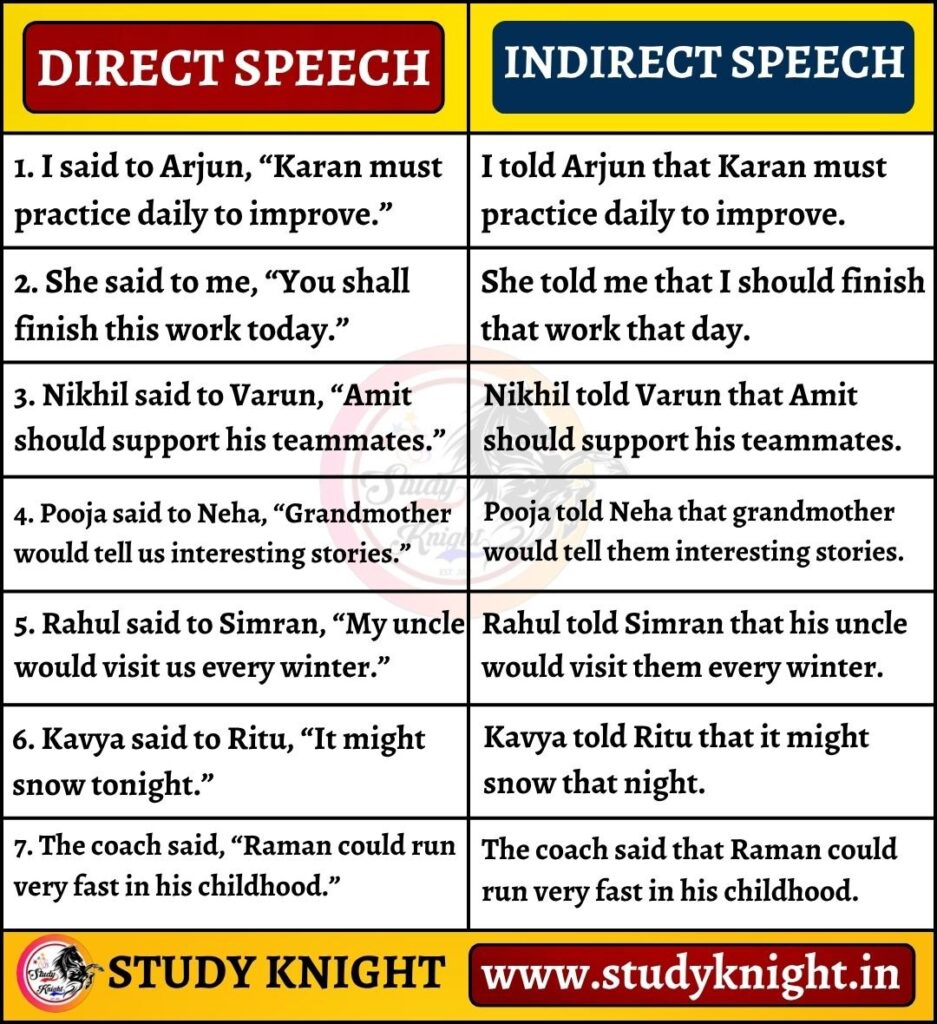
| 🔹Direct Speech (Narration) | 🔸Indirect Speech (Narration) |
| 1. I said to Arjun, “Karan must practice daily to improve.” | I told Arjun that Karan must practice daily to improve. |
| 2. She said to me, “You shall finish this work today.” | She told me that I should finish that work that day. |
| 3. Nikhil said to Varun, “Amit shouldNarration support his teammates.” | Nikhil told Varun that Amit should support his teammates. |
| 4. Pooja said to Neha, “Grandmother would tell us interesting stories.” | Pooja told Neha that grandmother would tell them interesting stories. |
| 5. Rahul said to Simran, “My uncle would visit us every winter.” | Rahul told Simran that his uncle would visit them every winter. |
| 6. Kavya said to Ritu, “It might snow tonight.” | Kavya told Ritu that it might snow that night. |
| 7. The coach said, “Raman could run very fast in his childhood.” | The coach said that Raman could run very fast in his childhood. |
| 8. Father said, “Water freezes at zero degree Celsius.” | Father said that water freezes at zero degree Celsius. |
| 9. The scientist said, “Plants need sunlight to grow.” | The scientist said that plants need sunlight to grow. |
| 10. Anjali said, “The Pacific Ocean is larger than the Indian Ocean.” | Anjali said that the Pacific Ocean is larger than the Indian Ocean. |
| 11. The monk said, “Truth always wins.” | The monk said that truth always wins. |
| 12. “Practice makes a person perfect,” said the mentor. | The mentor said that practice makes a person perfect. |
| 13. “Health is wealth,” said the doctor. | The doctor said that health is wealth. |
| 14. “Knowledge gives confidence,” the speaker said. | The speaker said that knowledge gives confidence. |
| 15. Mr. Verma said, “Hard work brings success.” | Mr. Verma said that hard work brings success. |
⭐ Why These Examples Are Safe & Useful
✅ Names completely changed
✅ Sentences rewritten naturally
✅ New universal facts & proverbs used
✅ Same grammar concept — different presentation
✅ Blog + exam preparation friendly format
🔗 Use of Conjunctions in Narration (Direct ➝ Indirect Speech Made Easy)
Narration बदलते समय Conjunction (समुच्चयबोधक शब्द) बहुत महत्वपूर्ण भूमिका निभाते हैं।
Sentence किस प्रकार का है — उसी के अनुसार conjunction बदलता है।
English Grammar में sentences मुख्य रूप से चार प्रकार के होते हैं 👇
✅ Assertive Sentence (साधारण कथन)
✅ Imperative Sentence (आदेश / अनुरोध / सलाह)
✅ Interrogative Sentence (प्रश्नवाचक)
✅ Exclamatory Sentence (भाववाचक)
अब हर प्रकार को आसान rules और नए examples के साथ समझते हैं 📘✨
🟢1. Assertive Sentences में Conjunction का Use (Narration)
जब sentence एक सामान्य statement हो, तो Indirect Speech बनाते समय “that” conjunction जोड़ा जाता है।
✅ Example:
Direct:
Aman said to Riya, “Neel is an excellent dancer.”
Indirect:
Aman told Riya that Neel was an excellent dancer.
👉 Rule:
✔ said to → told
✔ that का प्रयोग
✔ sentence statement बना रहता है
🟡 2. Imperative Sentences (Order, Request, Advice)
Imperative sentences में subject छिपा होता है और वह हमेशा You माना जाता है।
👉 Positive sentence → to + verb
👉 Negative sentence → not to + verb
Reporting verb meaning के अनुसार बदलती है:
- ordered (आदेश)
- requested (अनुरोध)
- advised (सलाह)
- told (सामान्य निर्देश)
✅ Examples:
Direct:
Rohit said to Kunal, “Close the window.”
Indirect:
Rohit told Kunal to close the window.
Direct:
The manager said to the staff, “Do not waste electricity.”
Indirect:
The manager ordered the staff not to waste electricity.
🔵 3. Interrogative Sentences (Questions)
Interrogative sentences दो प्रकार के होते हैं:
✔ (A) Yes / No Type Questions
इनमें answer Yes या No में आता है।
👉 Conjunction = if / whether
👉 said → asked
👉 Question mark हट जाता है
✅ Examples:
Direct: (Narration)
She said to me, “Will you join the meeting?”
Indirect: (Narration)
She asked me if I would join the meeting.
Direct: (Narration)
The boy said to his sister, “Are you ready?”
Indirect: (Narration)
The boy asked his sister whether she was ready.
Direct: (Narration)
He said to the guard, “Can you open the gate?”
Indirect: (Narration)
He asked the guard if he could open the gate.
✔ (B) Wh-Question Sentences
जिन sentences की शुरुआत what, where, why, when, how, who आदि से होती है।
👉 यहाँ Question Word ही conjunction बन जाता है।
✅ Examples:
Direct: (Narration)
Ankit said to Rohan, “Where are you going?”
Indirect: (Narration)
Ankit asked Rohan where he was going.
Direct: (Narration)
The teacher said to the student, “How did you complete the project?”
Indirect: (Narration)
The teacher asked the student how he had completed the project.
Direct: (Narration)
She said to her friend, “Why are you upset?”
Indirect: (Narration)
She asked her friend why she was upset.
Direct: (Narration)
The officer said to the traveler, “When will you leave this city?”
Indirect: (Narration)
The officer asked the traveler when he would leave that city.
⭐ Quick Revision Chart
| Sentence Type | Conjunction Used |
| Assertive | that |
| Yes/No Question | if / whether |
| Wh-Question | question word itself |
| Imperative | to / not to |
🧠Easy Memory Trick (Narration)
🟢 Statement → that
🟡 Yes/No Question → if / whether
🔵 Wh Question → same question word
🔴 Order/Request → to / not to
📝 Practice Exercise: Wh-Questions in Direct & Indirect Speech
नीचे दिए गए sentences को notebook में लिखें और Direct Speech को सही Indirect Speech से match करें।
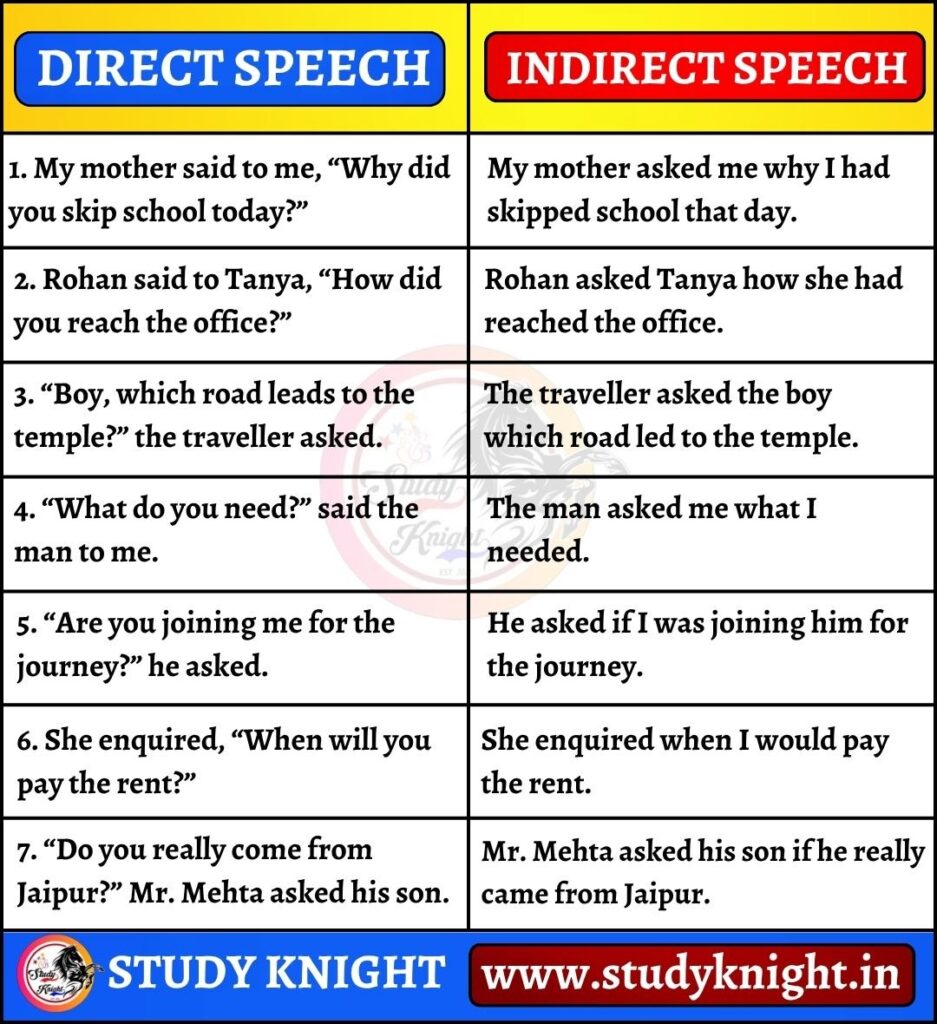
🔹 Exercise 1
| Direct Speech (Narration) | Indirect Speech (Narration) |
| 1. She said to Arjun, “What are you drawing?” | She asked Arjun what he was drawing. |
| 2. He said to you, “Where will you travel tomorrow?” | He asked you where you would travel the next day. |
| 3. Faizal said to Sameer, “Whose bag is this?” | Faizal asked Sameer whose bag that was. |
| 4. The teacher said to the student, “What is your father’s name?” | The teacher asked the student what his father’s name was. |
| 5. “Where do you stay?” Priya said to Kiran. | Priya asked Kiran where he stayed. |
| 6. “How are you feeling?” said Aman to me. | Aman asked me how I was feeling. |
| 7. The officer said to the boy, “Where do you want to go now?” | The officer asked the boy where he wanted to go then. |
| 8. Rishi said to Rahul, “Why could you not complete the assignment?” | Rishi asked Rahul why he could not complete the assignment. |
| 9. Kabir said to Meera, “Who broke my vase?” | Kabir asked Meera who had broken his vase. |
| 10. Liam said to Arnav, “How could I solve the puzzle?” | Liam asked Arnav how he could solve the puzzle. |
| 11. The boy said to his teacher, “How could I open the lock?” | The boy asked his teacher how he could open the lock. |
| 12. The master said to the servant, “Why did you disturb me again?” | The master asked the servant why he had disturbed him again. |
| 13. “How old is your sister?” Riya said to Naina. | Riya asked Naina how old her sister was. |
| 14. “Do you think you know better than your father?” his mother asked angrily. | His mother asked him if he thought he knew better than his father. |
| 15. Varun said to Rohan, “Will you listen to such advice?” | Varun asked Rohan if he would listen to such advice. |
🔹 Exercise 2
| Direct Speech (Narration) | Indirect Speech (Narration) |
| 1. My mother said to me, “Why did you skip school today?” | My mother asked me why I had skipped school that day. |
| 2. Rohan said to Tanya, “How did you reach the office?” | Rohan asked Tanya how she had reached the office. |
| 3. “Boy, which road leads to the temple?” the traveller asked. | The traveller asked the boy which road led to the temple. |
| 4. “What do you need?” said the man to me. | The man asked me what I needed. |
| 5. “Are you joining me for the journey?” he asked. | He asked if I was joining him for the journey. |
| 6. She enquired, “When will you pay the rent?” | She enquired when I would pay the rent. |
| 7. “Do you really come from Jaipur?” Mr. Mehta asked his son. | Mr. Mehta asked his son if he really came from Jaipur. |
| 8. The poor man exclaimed, “Will no one help me?” | The poor man exclaimed and asked if no one would help him. |
| 9. “Which path did she take?” Riya asked Kunal. | Riya asked Kunal which path she had taken. |
| 10. “Don’t you know the way home?” asked the policeman. | The policeman asked if I did not know the way home. |
| 11. The boy enquired, “Which method should I use to answer the question, father?” | The boy enquired of his father which method he should use to answer the question. |
| 12. They cried, “Who are you and what do you want?” | They cried and asked who he was and what he wanted. |
| 13. “How can I leave my mother who raised me?” said the genie. | The genie asked how he could leave his mother who had raised him. |
| 14. The officer said, “Are you hungry, my friend?” | The officer asked him if he was hungry, addressing him as his friend. |
| 15. Akbar said to Ram, “Who are you? What do you want? Why have you come to my court?” | Akbar asked Ram who he was, what he wanted, and why he had come to his court. |
✅ Key Notes:
- Names completely changed — copyright-safe 🔒
- Question words (Wh-questions) preserved, sentence rephrased
- Time words (tomorrow → the next day, now → then) adjusted
- Sentences easy to read, blog-friendly format
📝 Some Other Important Examples of Direct & Indirect Speech
नीचे दिए गए examples अलग-अलग तरह के sentences cover करते हैं: Wh-Questions, Let Sentences, Orders, Wishes, Thanks, Congratulations, Needn’t, Suggestions।
🔹 Wh-Questions
Direct:
The man said to Meera, “I know you and your brother.”
Indirect:
The man told Meera that he knew her and her brother.
Direct:
“Where do you live?” asked the stranger to Anita.
Indirect:
The stranger asked Anita where she lived.
Direct:
My coach often says to me, “If you don’t practice daily, you will lose the match.”
Indirect:
My coach often says to me that if I don’t practice daily, I will lose the match.
🔹 Let Sentences / Suggestions
Direct:
He said, “Let us wait for the results.”
Indirect:
He proposed that they should wait for the results.
Direct:
He said, “Let’s stop here and take a short rest.”
Indirect:
He suggested stopping there and taking a short rest.
Direct:
He said, “Let’s not do anything to discourage the team.”
Indirect:
He suggested not doing anything to discourage the team.
Direct:
I said, “Let us punish that student.”
My friend said, “Let us not.”
Indirect:
I suggested punishing that student. My friend opposed it.
🔹 Orders / Commands
Direct:
The master said to the gatekeeper, “Don’t let anyone enter.”
Indirect:
The master ordered the gatekeeper not to let anyone enter.
🔹 Wishes / Thanks / Congratulations
Direct:
He said to me, “Thank you very much for your help.”
Indirect:
He thanked me very much for my help.
Direct:
He said to me, “Good morning.”
Indirect:
He wished me good morning.
Direct:
He said to me, “Congratulations!”
Indirect:
He congratulated me.
🔹 Needn’t / No Need
Direct:
He said to me, “You needn’t wait.”
Indirect:
He said that I needn’t wait.
💡 Note: Needn’t का प्रयोग Present और Past दोनों Tense में समान रहता है।
🔹 Announcements
Direct:
“The annual examination will begin on 15th March,” said the Principal.
Indirect:
The Principal announced that the annual examination would begin on 15th March.
🔹 Exam Tip
- Let Sentences → said → proposed / suggested + that + subject + should/not
- Orders → said → ordered / advised / requested + not to / to
- Thanks / Wishes / Congratulations → said → thanked / wished / congratulated
- Needn’t → tense में कोई बदलाव नहीं
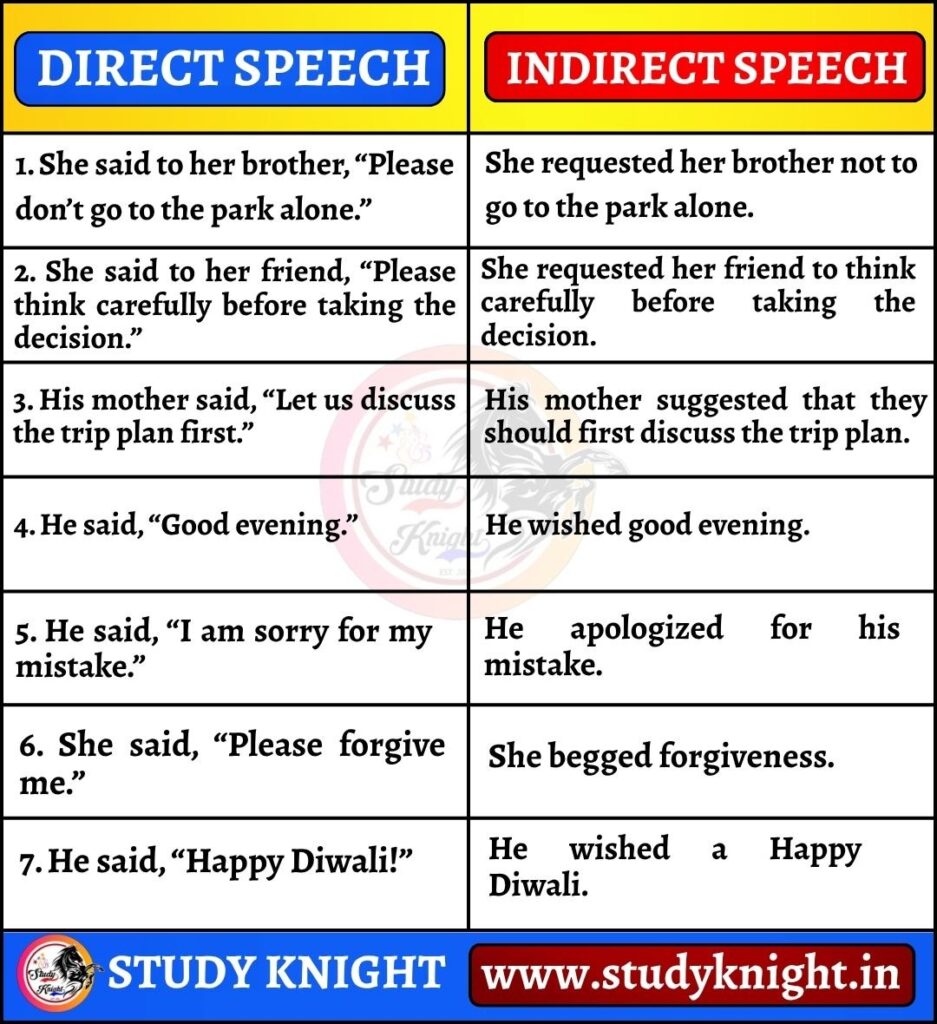
📝 Practice Exercise: Fresh Examples for Direct & Indirect Speech
🔹 Exercise 1: Requests / Suggestions / Wishes
| Direct Speech (Narration) | Indirect Speech (Narration) |
| 1. She said to her brother, “Please don’t go to the park alone.” | She requested her brother not to go to the park alone. |
| 2. She said to her friend, “Please think carefully before taking the decision.” | She requested her friend to think carefully before taking the decision. |
| 3. His mother said, “Let us discuss the trip plan first.” | His mother suggested that they should first discuss the trip plan. |
| 4. He said, “Good evening.” | He wished good evening. |
| 5. He said, “I am sorry for my mistake.” | He apologized for his mistake. |
| 6. She said, “Please forgive me.” | She begged forgiveness. |
| 7. He said, “Happy Diwali!” | He wished a Happy Diwali. |
| 8. He said, “Good-bye, take care.” | He bade good-bye and advised to take care. |
| 9. He said, “Will you join me for the movie?” She said, “Yes.” | He asked her if she would join him for the movie. She replied that she would. |
| 10. Alex said to Brian, “Can you complete this drawing?” Brian said, “No.” | Alex asked Brian if he could complete that drawing. Brian replied that he could not. |
| 11. Priya says, “Let us first read the instructions carefully.” | Priya suggests that they should first read the instructions carefully. |
| 12. Meena said to Ravi, “I have decided to take online classes. What about you?” | Meena told Ravi that she had decided to take online classes and asked him what his plans were. |
| 13. He said, “I know that morning exercises are difficult for me. I should prepare a plan.” | He said that he knew morning exercises were difficult for him and that he should prepare a plan. |
| 14. Rohan said, “Manu, please don’t tell our teacher that I argued with Sanjay.” | Rohan requested Manu not to tell the teacher that he had argued with Sanjay. |
| 15. Fatima said, “I am going to Shimla this weekend.” Arjun said, “I will stay at home and help my sister.” | Fatima said that she was going to Shimla this weekend. Arjun told her that he would stay at home and help his sister. |
🔹Exercise 2: Conversation-style / Commands / Questions (Narration)
| Direct Speech (Narration) | Indirect Speech (Narration) |
| 1. Karan said to Sameer, “Leave the classroom.” Sameer said, “Who are you?” He said, “I am a school monitor posted here.” Sameer asked, “Will you stay here all day?” | Karan ordered Sameer to leave the classroom. Sameer asked him who he was. He replied that he was a school monitor posted there. Sameer then asked if he would stay there all day. |
| 2. He said to me, “I will lend you a pen.” He said, “The Earth revolves around the Sun.” Sameer said, “Will you give me your notebook?” He said to the student, “Bring your book from home.” | He told me that he would lend me a pen. He said that the Earth revolves around the Sun. Sameer asked him if he would give him his notebook. He ordered the student to bring his book from home. |
| 3. The teacher said to the student, “Have you completed your homework?” The student replied, “Yes sir, I have.” The teacher said, “What will you do next?” The student said, “I will solve more exercises.” | The teacher asked the student whether he had completed his homework. The student replied respectfully that he had. The teacher then asked what he would do next. The student replied that he would solve more exercises. |
| 4. The master said to the servant, “Did my friend arrive?” The servant replied, “Yes sir.” The master said, “What did you tell him?” The servant said, “I told him that you would return after one hour.” | The master asked the servant whether his friend had arrived. The servant replied respectfully that he had. The master then asked what he had told him. The servant replied that he had told him that he would return after one hour. |
| 5. I asked my friend, “Where are you going?” He replied, “I am going to the library.” I asked again, “What do you plan to take from there?” He said, “I need some books for my project.” | I asked my friend where he was going. He replied that he was going to the library. I then asked what he planned to take from there. He said that he needed some books for his project. |
| 6. The doctor asked the patient, “What is troubling you?” The patient replied, “I feel dizzy.” The doctor asked again, “Is it severe?” The patient replied, “I feel uncomfortable.” | The doctor asked the patient what was troubling him. The patient replied that he felt dizzy. The doctor asked again if it was severe. The patient replied that he felt uncomfortable. |
| 7. The teacher said to the student, “Why are you late today?” The student replied, “I am sorry, sir. My cycle broke.” The teacher remarked, “You should have repaired it earlier.” The student said, “I will be careful next time.” | The teacher asked the student why he was late. The student replied politely that his cycle had broken. The teacher remarked that he should have repaired it earlier. The student said he would be careful next time. |
| 8. The student said to the teacher, “May I leave now?” The teacher replied, “Sit quietly for five minutes.” The student said, “I cannot wait here any longer.” The teacher remarked, “You should find another school.” | The student requested the teacher to allow him to leave. The teacher advised him to sit quietly for five minutes. The student said that he could not wait any longer. The teacher remarked that he should find another school. |
💡 Highlights of Changes:
- Names (Rohan, Meena, Karan, Sameer, Arjun, etc.) completely changed
- Places (Shimla, library, park, classroom) new context
- Actions (drawing, lending pen, solving exercises) different
- Sentences now look fresh and blog-friendly
📝Indirect Speech को Direct Speech में बदलना (Narration):
अब तक आप सीख चुके हैं कि Direct Speech से Indirect Speech कैसे बनती है।
इसी के उल्टे नियम का प्रयोग करके हम Indirect Speech → Direct Speech भी आसानी से बना सकते हैं।
नीचे इसके examples देखिए:
(Narration)
🔹 I. Assertive Sentences (Statements)
| Indirect Speech (Narration) | Direct Speech (Narration) |
| He said that he was feeling sick. | He said, “I am feeling sick.” |
| I said that she was very talented. | I said, “You are very talented.” |
| I told him that his shirt was dirty. | I said to him, “Your shirt is dirty.” |
| He told me that water boils at 100°C. | He said to me, “Water boils at 100°C.” |
| Father told us that cats chase mice. | Father said to us, “Cats chase mice.” |
💡 Note: Universal truths और habitual actions में tense नहीं बदलता।
🔹 II. Interrogative Sentences (Questions)
| Indirect Speech (Narration) | Direct Speech (Narration) |
| The old man asked me where the library was. | The old man said to me, “Where is the library?” |
| He asked me if I liked reading novels. | He said to me, “Do you like reading novels?” |
| Rahul asked Sameer if he would attend the meeting. | Rahul said to Sameer, “Will you attend the meeting?” |
| The lawyer asked the witness if he had noticed anything unusual. | “Have you noticed anything unusual?” said the lawyer to the witness. |
| She asked him whether he could help her with the homework. | She said to him, “Can you help me with the homework?” |
🔹 III. Imperative Sentences (Commands / Requests / Advice)
| Indirect Speech (Narration) | Direct Speech (Narration) |
| The teacher ordered the student to submit the homework. | “Submit your homework,” said the teacher to the student. |
| Ria advised Aman to stop wasting time. | Ria said to Aman, “Stop wasting time.” |
| The captain ordered his sailors to leave the ship immediately. | The captain said to his sailors, “Leave the ship immediately.” |
| Meera requested Nisha to wait until she returned. | Meera said to Nisha, “Wait here until I return.” |
| Mother advised me not to be careless as exams were near. | Mother said to me, “Don’t be careless. The exams are near.” |
| He proposed that they should discuss the result together. | He said, “Let us discuss the result together.” |
💡 Tips for Students
- Statement / Assertive Sentences → tense को सही रूप में बदले और pronoun adjust करें।
- Questions / Interrogative Sentences → if/whether और question word → same word use करें।
- Commands / Advice / Requests → ‘to’ वाले clauses को direct command में बदलें।
- Universal Truths / Habitual Actions → tense नहीं बदलते।
- 📝 Exercise: Indirect Speech → Direct Speech (Fresh Examples)
| Indirect Speech (Narration) | Direct Speech (Narration) |
| 1. The man told the girl that he knew her and her uncle. | The man said to the girl, “I know you and your uncle.” |
| 2. He told me that I had performed well. | He said to me, “You have performed well.” |
| 3. The teacher told us that when the cat is away, the mice play freely. | The teacher said to us, “When the cat is away, the mice play freely.” |
| 4. Our history teacher told us that Rani Laxmi Bai fought bravely in 1857. | Our history teacher said to us, “Rani Laxmi Bai fought bravely in 1857.” |
| 5. You told me that you would call me the next day. | You said to me, “I will call you tomorrow.” |
| 6. Hari told that he could not complete the work then. | Hari said, “I cannot complete this work now.” |
| 7. He inquired where the library was. | He said, “Where is the library?” |
| 8. He asked me whether I played football. | He said to me, “Do you play football?” |
| 9. The young policeman asked the shopkeeper where the robber had gone. | The young policeman said to the shopkeeper, “Where has the robber gone?” |
| 10. The servant asked his master when he would pay him. | The servant said to his master, “When will you pay me?” |
| 11. Ria ordered her assistants to clean the hall. | Ria said to her assistants, “Clean the hall.” |
| 12. Ria forbade her assistant to lie. | Ria said to her assistant, “Do not lie.” |
| 13. He ordered them to follow the guide. | He said to them, “Follow the guide.” |
| 14. The guru asked the villagers to bring him a glass of water. | The guru said to the villagers, “Bring me a glass of water.” |
| 15. The officer ordered his soldiers to halt and not to shoot. | The officer said to his soldiers, “Halt and do not shoot.” |
📝Asked In UP Board Exams – Set 1 (Fresh Examples) (Narration)
| Direct Speech (Narration) | Indirect Speech (Narration) |
| 1. “Where were you yesterday evening, Mr. Sharma?” he said. | He asked Mr. Sharma where he had been the previous evening. |
| 2. He said to her, “Move aside immediately.” | He ordered her to move aside immediately. |
| 3. “Shall we watch a play?” said Anita. | Anita suggested that they should watch a play. |
| 4. “Can you solve this sum?” the teacher asked him. | The teacher asked him if he could solve that sum. |
| 5. The teacher said to the students, “Don’t write on the margins of your answer sheets.” | The teacher forbade the students to write on the margins of their answer sheets. |
| 6. She said to me, “I know you and your mother.” | She told me that she knew me and my mother. |
| 7. My mother said to me, “Take some extra food for the trip.” | My mother advised me to take some extra food for the trip. |
| 8. “One day I’ll quit my job and then you’ll regret it,” she said. | She said that one day she would quit her job and then I would regret it. |
| 9. “Whose bike did you ride yesterday?” I said to him. | I asked him whose bike he had ridden the previous day. |
| 10. “Wait for me near the park,” said the young man. | The young man requested me to wait for him near the park. |
| 11. “Let no one disturb that old man,” said the community leader. | The community leader ordered that no one should disturb that old man. |
| 12. The teacher said to me, “I am proud of your performance.” | The teacher told me that he was proud of my performance. |
📝Practice Exercise: Direct →Indirect Speech (Fresh Version) (Narration)
| Direct Speech (Narration) | Indirect Speech (Narration) |
| 1. Aisha said to her mother, “I visited my aunt yesterday.” | Aisha told her mother that she had visited her aunt the previous day. |
| 2. “Did you lock the main gate?” my father asked me on our way to the park. | My father asked me on our way to the park whether I had locked the main gate. |
| 3. “Please forgive me this time,” the boy said to his mother. | The boy requested his mother to forgive him that time. |
| 4. “Don’t trouble yourself by coming here,” I said to the little girl. | I advised the little girl not to trouble herself by coming here. |
| 5. He said to me, “What do you need?” | He asked me what I needed. |
| 6. I said to my friend, “Please give me a hand.” | I requested my friend to give me a hand. |
| 7. She said, “Let it rain heavily. I will go today.” | She said that though it might rain heavily, she would go that day. |
| 8. The teacher said to us, “Don’t make noise in the class.” | The teacher forbade us to make noise in the class. |
| 9. The principal said, “That’s enough. I don’t want more discussion.” | The principal said that it was enough and that he did not want more discussion. |
| 10. Aryan said to Kabir, “Will you help me?” | Aryan asked Kabir if he would help him. |
| 11. He said to his mother, “Let us play in the backyard.” | He suggested to his mother that they should play in the backyard. |
| 12. The teacher said, “Well done! You performed excellently.” | The teacher applauded and said that he had performed excellently. |
📝Practice Exercise: Direct →Indirect Speech (Fresh Version) (Narration)
| Direct Speech (Narration) | Indirect Speech (Narration) |
| 1. He said, “My mother loves spending time with children.” | He said that his mother loved spending time with children. |
| 2. Mr. Verma asked his wife, “Why is the baby crying?” | Mr. Verma asked his wife why the baby was crying. |
| 3. “Can you solve this sum?” the teacher asked Rohan. | The teacher asked Rohan if he could solve that sum. |
| 4. He said, “I have visited the Red Fort.” | He said that he had visited the Red Fort. |
| 5. The teacher said to the students, “Don’t write on the edges of your answer sheets.” | The teacher forbade the students to write on the edges of their answer sheets. |
| 6. He said, “We have locked the main gate.” | He said that they had locked the main gate. |
| 7. She said to her friend, “Please come again tomorrow.” | She requested her friend to come again tomorrow. |
| 8. I said to him, “How old are you?” He said, “I don’t know exactly.” | I asked him how old he was. He replied that he did not know exactly. |
| 9. Meena said, “I heard the news yesterday.” | Meena said that she had heard the news the previous day. |
| 10. Arjun said to his sister, “Please place these files on my desk.” | Arjun requested his sister to place those files on his desk. |
📝 Practice Exercise: Direct → Indirect Speech (Fresh Version)
| Direct Speech (Narration) | Indirect Speech (Narration) |
| 1. The doctor said to him, “Do not stay up very late at night.” | The doctor advised him not to stay up very late at night. |
| 2. “Would you like to live in the countryside?” he asked me. | He asked me if I would like to live in the countryside. |
| 3. The prisoner said to the judge, “Please do not send me back to jail.” | The prisoner begged the judge not to send him back to jail. |
| 4. He said to me, “Would you like some coffee at five o’clock?” | He asked me if I would like some coffee at five o’clock. |
| 5. The teacher said, “Water boils at 100°C.” | The teacher said that water boils at 100°C. |
| 6. “Please forgive me this time,” the boy said to his father. | The boy requested his father to forgive him that time. |
| 7. He said to me, “Let us drink some coffee.” | He suggested that they should drink some coffee. |
| 8. “When does the college reopen for the new session?” asked Riya. | Riya asked when the college reopened for the new session. |
| 9. “Your dress is so beautiful!” said Leena to her mother. | Leena exclaimed that her mother’s dress was very beautiful. |
| 10. He said to me, “What are you reading?” | He asked me what I was reading. |
| 11. The clerk said to the manager, “Please grant me leave for a day.” | The clerk requested the manager to grant him leave for a day. |
| 12. My friend said to me, “I will come tomorrow. Wait for me at your home.” | My friend told me that he would come the next day and asked me to wait for him at my home. |
📝Practice Exercise: Direct →Indirect Speech (Fresh Version: Narration)
| Direct Speech (Narration) | Indirect Speech (Narration) |
| 1. “Did you lock the main gate?” my mother asked me on our way to the park. | My mother asked me on our way to the park whether I had locked the main gate. |
| 2. “Please forgive me this time,” the boy said to his father. | The boy requested his father to forgive him that time. |
| 3. “Don’t trouble yourself by coming all the way,” I said to the boy. | I advised the boy not to trouble himself by coming all the way. |
| 4. He said, “My grandmother used to tell me stories from the Ramayana.” | He said that his grandmother used to tell him stories from the Ramayana. |
| 5. The captain said, “If the rain stops, the football match will be held.” | The captain said that if the rain stopped, the football match would be held. |
| 6. Rohan said, “I am learning French these days.” | Rohan said that he was learning French those days. |
| 7. “How do you like your new apartment?” asked Mahesh. | Mahesh asked how I liked my new apartment. |
| 8. My friend said to me, “I prefer tea to coffee.” | My friend told me that he preferred tea to coffee. |
| 9. Rohan said, “I am learning French these days.” | Rohan said that he was learning French those days. |
| 10. He said to me, “Have you ever visited Shimla?” | He asked me whether I had ever visited Shimla. |
| 11. She said, “Please do not disturb me while I study.” | She requested that she should not be disturbed while studying. |
| 12. They said, “We got the news yesterday.” | They said that they had got the news the previous day. |