
Verbs in English Grammar: Meaning, Types, Functions and Easy Examples
Verb and Its Types
Verbs are a very important part of speech in every language, including English. They are used to show actions, states, events, or processes. In English grammar, verbs perform several key functions and help in forming meaningful sentences.
What are Verbs?
Verbs are one of the basic parts of speech in English Grammar as well as in many other languages. They are words that indicate an action, a condition, an occurrence, or a process.
Verb (क्रिया) शब्द लैटिन भाषा के Verbum शब्द से बना है। Verbum का अर्थ है— “a word (एक शब्द)”。 Verb वाक्य का केंद्रीय शब्द होता है। Verb के बिना कोई भी वाक्य पूर्ण नहीं होता। यदि वाक्य में केवल एक ही शब्द हो, तो वह भी Verb हो सकता है; जैसे—
Stop.
You are present.
God is kind.
She washes.
Complete your task.
Hari reached here.
Mohan writes a letter.
I am leaving now.
He has been studying a lesson for two hours.
I shall have been studying a lesson for two hours.
ध्यान दीजिए कि—
प्रत्येक वाक्य में Verb का होना अनिवार्य है।
Verb एक शब्द का हो सकता है। (वाक्य 1, 2, 3, 4, 5, 6, 7)
Verb दो शब्द का हो सकता है। (वाक्य 8)
Verb तीन शब्द का हो सकता है। (वाक्य 9)
Verb में अधिकतम चार शब्द हो सकते हैं। (वाक्य 10)
Definition of Verb
क्रिया (Verb) वह शब्द है जिसका प्रयोग किसी व्यक्ति, स्थान या वस्तु के बारे में कुछ बताने के लिए किया जाता है।
A Verb is a word that is used to say something about a person, place, or thing.
Examples of Verb in Sentences:
The girl wrote a letter.
Delhi is a large city.
He played cricket.
The earth moves around the sun.
Iron and copper are useful metals.
The sun rises in the east.
उपर्युक्त वाक्यों में wrote, is, are, played, rises, moves क्रियाएँ (Verbs) हैं।
KINDS OF VERB
Verbs सामान्यतः चार प्रकार की होती हैं—
Transitive Verb (सकर्मक क्रिया)
Intransitive Verb (अकर्मक क्रिया)
Linking Verb (संयोजक क्रिया)
Auxiliary / Helping Verb (सहायक क्रिया)
MAIN VERB
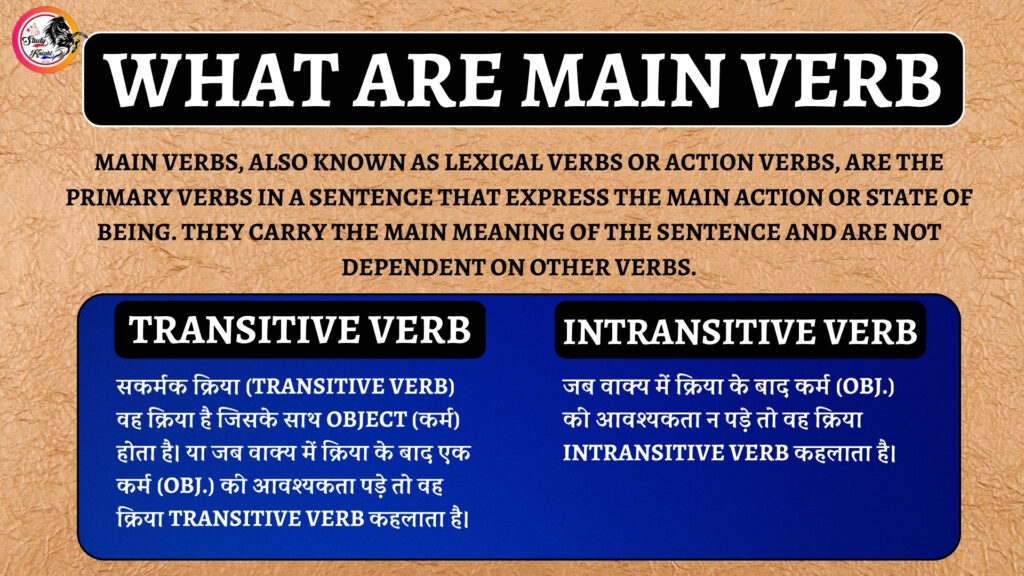
Main verbs, also called lexical verbs or action verbs, are the chief verbs in a sentence that show the main action or the state of being. They carry the central meaning of the sentence and do not depend on other verbs for their meaning.
She sings melodiously.
They participated in the marathon.
उपर्युक्त दोनों वाक्यों में “sings” और “participated” मुख्य क्रियाएँ हैं।
Popular types of Main Verbs: Transitive Verbs and Intransitive Verbs.
TRANSITIVE VERB
सकर्मक क्रिया (Transitive Verb) वह क्रिया होती है जिसके साथ Object (कर्म) का प्रयोग किया जाता है। जब किसी वाक्य में क्रिया के बाद कर्म की आवश्यकता होती है, तो उस क्रिया को Transitive Verb कहा जाता है। जैसे—
Mohan played (v) football (obj.). मोहन ने फुटबॉल खेली।
Ram gave (v) Hari (obj.) a pen. राम ने हरी को एक पेन दिया।
I write (v) a story (obj.).
Children fly (v) paper planes (obj.).
पहले वाक्य में football का प्रयोग played क्रिया के Object के रूप में हुआ है, इसलिए played एक Transitive Verb है।
How to find object in a sentence?
कर्म ज्ञात करने की विधि— क्रिया के साथ ‘क्या’ और ‘किसे / किसको’ लगाकर प्रश्न करने पर उत्तर में जो Noun या Pronoun प्राप्त होता है, वही उस क्रिया का कर्म (Object) होता है।
प्रथम वाक्य के लिए—
प्रश्न— मोहन ने क्या खेला था?
उत्तर— मोहन ने फुटबॉल खेली थी।
अतः football इस वाक्य में played क्रिया का Object है।
इसी प्रकार दूसरे वाक्य के लिए—
प्रश्न 1— राम ने हरी को क्या दिया?
उत्तर— राम ने एक पेन दिया।
अतः pen gave क्रिया का Object है।
प्रश्न 2— राम ने पेन किसे दिया?
उत्तर— राम ने पेन हरी को दिया।
अतः Hari gave क्रिया का Object है।
इस प्रकार gave एक ऐसी सकर्मक क्रिया है जिसके दो Objects होते हैं।
टिप्पणी— सकर्मक क्रियाओं के साथ अधिकतम दो Objects आ सकते हैं। प्रत्येक सकर्मक क्रिया के साथ कम से कम एक Object का होना आवश्यक है।
How to find subject in a sentence?
कर्ता (Subject) ज्ञात करने की विधि— क्रिया के साथ ‘कौन’ या ‘किसने’ लगाकर प्रश्न करने पर उत्तर में जो Noun या Pronoun प्राप्त होता है, वही उस क्रिया का कर्ता (Subject) होता है।
प्रथम वाक्य के लिए—
प्रश्न— फुटबॉल किसने खेली?
उत्तर— मोहन
अतः Mohan इस वाक्य का Subject है।
INTRANSITIVE VERB
जब वाक्य में क्रिया के बाद कर्म (Object) की आवश्यकता नहीं होती, तो ऐसी क्रिया को Intransitive Verb कहा जाता है। जैसे—
Birds fly.
She slept.
नोट— यदि Verb Transitive होती है, तो केवल Verb लिखने से ही ‘क्या’ या ‘किसे’ जैसे प्रश्न उत्पन्न होते हैं।
He broke. (क्या?)
He broke a glass.
I assisted. (किसे?)
I assisted him.
Some more examples of Intransitive Verb:
Sita will leave.
Mira is arriving.
Rani has returned.
Madan was swimming.
उपर्युक्त वाक्यों में will leave, is arriving, has returned और was swimming अकर्मक क्रियाएँ हैं। इन क्रियाओं के साथ कोई Object नहीं आता।
One Object | Two Objects |
Manish writes a letter. | Manish gave me a pen. |
Sakshi has sung a song. | Sakshi asked me a doubt. |
She told a lie. | She told us incidents. |
The teacher has guided me. | The teacher has taught me English. |
उपर्युक्त उदाहरणों को ध्यान से देखने पर यह बात स्पष्ट होती है कि—
दोनों कॉलमों में तिरछे लिखी गई क्रियाएँ सकर्मक क्रियाएँ (Transitive Verbs) ही हैं।
पहले कॉलम में प्रयुक्त प्रत्येक सकर्मक क्रिया के साथ केवल एक ही कर्म (Object) दिया गया है।
दूसरे कॉलम में भी वही क्रियाएँ ली गई हैं, जो पहले कॉलम में थीं, लेकिन उनका प्रयोग अलग ढंग से किया गया है।
दूसरे कॉलम में इन क्रियाओं के साथ दो कर्म (Objects) का प्रयोग हुआ है।
संकेत 🙂— सामान्यतः क्रिया के तुरंत बाद Indirect Object आता है और उसके बाद Direct Object प्रयुक्त होता है।
Direct Object वह होता है जो क्रिया के साथ ‘क्या’ (What) लगाने पर प्राप्त होता है,
जबकि Indirect Object वह होता है जो क्रिया के साथ ‘किसको’ (Whom) लगाने पर मिलता है।
Transitive Verbs with Object and Complement
सकर्मक क्रियाओं में Object और Complement को समझने के लिए निम्नलिखित उदाहरणों पर ध्यान दीजिए—
He called me.
He told us stories.
He called me a liar.
पहले वाक्य में called क्रिया है और इसका Object me है।
दूसरे वाक्य में told एक सकर्मक क्रिया है, जिसके साथ दो Objects— us और stories— प्रयोग किए गए हैं।
तीसरे वाक्य को ध्यान से समझना आवश्यक है 🙂। इस वाक्य का अर्थ है— उसने मुझे झूठा कहा।
He called me का अर्थ केवल इतना है— उसने मुझे कहा। यह वाक्य अपने आप में अधूरा है।
क्या कहा?— liar
अतः इस वाक्य में a liar क्रिया का Complement है, जो वाक्य के भाव को पूर्ण करता है।
इससे यह निष्कर्ष निकलता है कि—
कुछ सकर्मक क्रियाएँ ऐसी होती हैं जिनके साथ केवल एक Object आता है।
कुछ सकर्मक क्रियाओं के साथ दो Objects होते हैं—
(1) Indirect Object तथा (2) Direct Object।
ऐसी क्रियाओं में प्रायः Indirect Object पहले और Direct Object बाद में आता है, लेकिन आवश्यकता पड़ने पर इनके स्थान बदले भी जा सकते हैं 😊।
जब Direct Object पहले आता है, तो Indirect Object से पहले वाक्य के भाव के अनुसार to या for का प्रयोग किया जाता है।
कुछ Transitive Verbs ऐसी भी होती हैं जिनमें Object के बाद अर्थ को पूर्ण करने के लिए Complement का प्रयोग अनिवार्य होता है।
Subjective Complement and Objective Complement
पूरक (Complements) मुख्य रूप से दो प्रकार के होते हैं—
Subjective Complement (Subject Complement)
Objective Complement (Object Complement)
Subjective Complement:
जब कोई Complement वाक्य के Subject के बारे में अतिरिक्त जानकारी देता है और उसे स्पष्ट करता है, तो उसे Subjective Complement कहा जाता है। उदाहरण—
Manish became a soldier.
Man Mohan Singh became Finance Minister.
Binni is a girl.
Objective Complement:
जब कोई Complement वाक्य में प्रयुक्त Object के बारे में अतिरिक्त जानकारी देता है और उसे स्पष्ट करता है, तो ऐसे Complement को Objective Complement (या Object Complement) कहा जाता है। उदाहरण—
She painted the wall white.
We chose him leader.
They considered the plan successful 🙂.
He named his dog Bruno.
The team announced the match a draw.
Transitive Verbs and Intransitive Verbs
निम्न उदाहरणों को ध्यान से पढ़िए—
Transitive Verb | Intransitive Verb |
The train halted. | The driver halted the train. |
The boy ran. | The boy ran a competition 🙂. |
The bell is ringing. | The peon is ringing the bell. |
Do not play now. | Do not play football. |
इस प्रकार यह स्पष्ट हो जाता है कि कुछ क्रियाएँ (Verbs) ऐसी होती हैं जिनका प्रयोग Transitive और Intransitive दोनों रूपों में किया जा सकता है 🙂।
RULE:
यदि किसी Verb के साथ Object उपस्थित हो, तो वह Verb सकर्मक (Transitive) कहलाती है।
यदि Verb के साथ कोई कर्म (Object) न हो, तो वह क्रिया अकर्मक (Intransitive) मानी जाती है।
NOTE:
विद्यार्थी ध्यान रखें कि यह नियम Linking Verbs पर लागू नहीं होता, क्योंकि Linking Verbs के साथ Object के स्थान पर Complement (पूरक) का प्रयोग किया जाता है।
LINKING VERB
संयोजक क्रिया (Linking Verb) वह क्रिया होती है जो वाक्य के Subject को उसके Complement (पूरक) से जोड़ने का कार्य करती है; जैसे—
Mohan is honest.
इस वाक्य में is क्रिया है। Mohan क्रिया का कर्ता (Subject) है और honest क्रिया का पूरक (Complement) है।
इस वाक्य में केवल तीन शब्द हैं— Mohan, is और honest।
अतः स्पष्ट है कि is का कार्य Mohan और honest के बीच संबंध स्थापित करना है 😊।
इसी प्रकार की क्रिया को Linking Verb कहा जाता है।
Linking Verb को Intransitive Verb of Incomplete Predication भी कहा जाता है।
Some more examples of Linking Verb:
The earth is round.
You are a student.
They were poor.
This house is to let 🙂.
I am a teacher.
Sita was beautiful.
ध्यान दीजिए कि—
Is, am, are, was, were क्रियाएँ ‘Be’ क्रिया के अलग-अलग रूप हैं।
Linking Verb के साथ प्रयुक्त Complement (पूरक) प्रायः Noun (या Noun के समान कार्य करने वाला शब्द) या Adjective (या Adjective के समान कार्य करने वाला शब्द) होता है।
Main Verbs as Linking Verbs
Linking Verbs Other Than ‘Be’:
‘Be’ क्रिया के रूपों (is, am, are, was, were) के अतिरिक्त कुछ अन्य Main Verbs भी Linking Verbs के रूप में प्रयोग किए जाते हैं। ये इस प्रकार हैं—
Come,
get,
go,
grow,
feel,
run,
appear,
become,
look,
remain,
seem.
जैसा कि ऊपर बताया गया है, Main Verbs तब Linking Verbs के रूप में कार्य करते हैं जब वे Subject की अवस्था या स्थिति को प्रकट करते हैं। Linking Verbs, Subject को उसके बारे में दी गई जानकारी से जोड़ते हैं, जिसे Subject Complement कहा जाता है।
Examples in Sentences:
The news came true.
He felt offended.
It became dark 🙂.
Food supply ran short.
She grew angry.
Your guess went wrong.
इन वाक्यों में came, felt, became, ran और grew आदि संयोजक क्रियाएँ (Linking Verbs) हैं। ये बिना किसी कार्य को व्यक्त किए वाक्य के कर्ता (The news, He, It, Food supply, She, Your guess) को उसके पूरक (true, offended, dark, short, angry, wrong) से जोड़ती हैं।
Linking Verb Tip:
Linking Verb को समझने का एक आसान तरीका यह है कि उसे बराबर के चिह्न (=) के रूप में सोचें 😊। यदि किसी वाक्य में Main Verb के स्थान पर (=) रखने पर भी वाक्य अर्थपूर्ण लगे, तो वह Main Verb Linking Verb होता है।
AUXILIARY VERBS (HELPING VERBS)
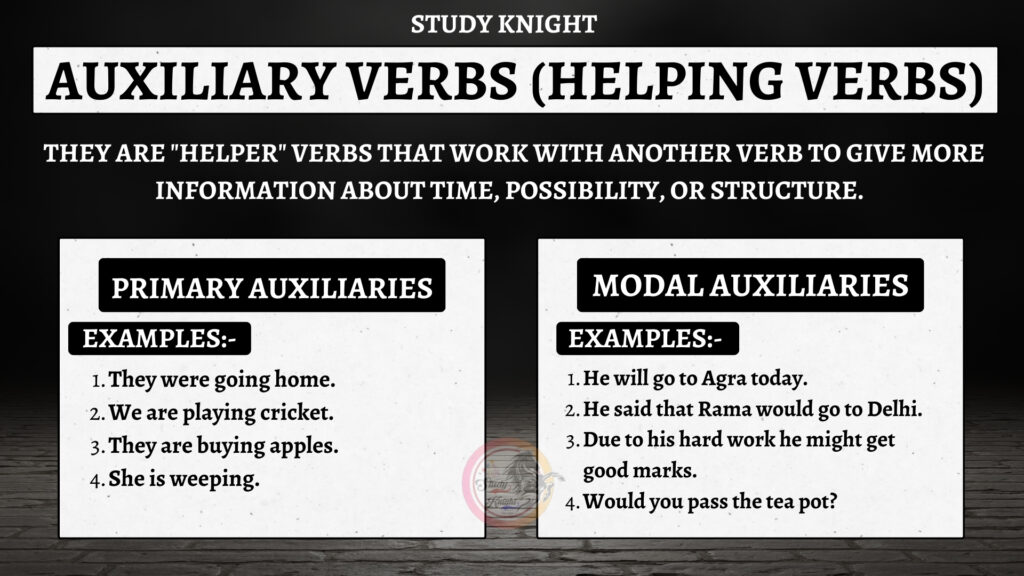
जो क्रिया वाक्य में मुख्य क्रिया के साथ मिलकर Tense (काल) बनाने में सहायता करती है, उसे सहायक क्रिया (Auxiliary Verb या Helping Verb) कहा जाता है।
An auxiliary verb works as a supporting verb with the main verb in a sentence. It helps in expressing time, mood, completion, or certainty of an action and makes the sentence grammatically complete 🙂।
निम्नलिखित उदाहरणों को ध्यान से पढ़िए—
Hari is reading a book.
Mohan has written a letter.
Gopal will go to Agra.
Mira was singing a song.
पहले वाक्य में is reading क्रिया है, जिसके दो भाग हैं—
(i) is और (ii) reading
दूसरे वाक्य में has written क्रिया है, जिसके दो भाग हैं—
(i) has और (ii) written
तीसरे वाक्य में will go क्रिया है, जिसके दो भाग हैं—
(i) will और (ii) go
चौथे वाक्य में was singing क्रिया है, जिसके दो भाग हैं—
(i) was और (ii) singing
इन वाक्यों में क्रमशः पढ़ने, लिखने, जाने और गाने का कार्य हुआ है। इसलिए reading, written, go और singing मुख्य क्रियाएँ (Main Verbs) हैं।
जबकि is, has, will, was का प्रयोग Tense बनाने के लिए किया गया है, अतः ये सहायक क्रियाएँ (Auxiliary या Helping Verbs) हैं 😊।
Kinds of Auxiliary Verbs
सहायक क्रियाएँ (Helping Verbs / Auxiliary Verbs) सामान्यतः दो प्रकार की होती हैं—
Primary Auxiliaries (प्राथमिक सहायक क्रियाएँ)
Modal Auxiliaries (विधिसूचक सहायक क्रियाएँ)
Modal Auxiliaries को आजकल संक्षेप में Modals भी कहा जाता है।
PRIMARY AUXILIARIES
Primary Auxiliaries में निम्न क्रियाओं के विभिन्न रूप सम्मिलित होते हैं—
Be — Is, Am, Are, Was, Were
Have — Have, Has, Had
Do — Do, Does, Did
Is, am, are, was, were का प्रयोग सहायक क्रिया के रूप में Continuous (Progressive) Tenses में किया जाता है। इनके साथ Main Verb में -ing जोड़ा जाता है।
Have, has, had का प्रयोग Present Perfect तथा Past Perfect Tense में सहायक क्रिया के रूप में होता है। इन Tenses में Main Verb की Third Form (Past Participle) का प्रयोग किया जाता है।
Do और does का प्रयोग Present Indefinite Tense (Simple Present) में सहायक क्रिया के रूप में किया जाता है। ऐसे वाक्यों में Main Verb की First Form (Base Form) आती है।
Did का प्रयोग Past Indefinite Tense (Simple Past) में किया जाता है। इसका उपयोग वाक्य को प्रश्नवाचक या Negative बनाने में होता है। इस स्थिति में Did के साथ भी Verb की First Form ही प्रयुक्त होती है।
Examples of Primary Auxiliary Verbs:
He is sleeping.
I am reading a book.
You are bathing in the Ganga.
He was writing a letter.
They were going home.
We are playing cricket.
They are buying apples.
She is crying 🙂.
इन वाक्यों में Be क्रिया के विभिन्न रूप— is, am, are, was, were— का प्रयोग हुआ है।
I have completed my work.
We have cleaned our clothes.
He has purchased a bicycle.
He had reached there before sunset.
इन वाक्यों में Have क्रिया के रूप— have, has, had— प्रयुक्त हुए हैं।
Do you like mangoes?
Did Mohan help you last year?
Does he not work sincerely?
He did not go there.
इन वाक्यों में Do क्रिया के रूप— do, does, did— सहायक क्रिया के रूप में स्पष्ट दिखाई देते हैं।
Primary Auxiliaries Vs. Main Verbs
Primary Auxiliaries और Main Verbs के रूप में is, am, are, was, were, have, has, had, do, does तथा did— इन सभी क्रियाओं का प्रयोग किया जा सकता है। कभी ये सहायक क्रिया (Primary Auxiliary) के रूप में आती हैं और कभी मुख्य क्रिया (Main Verb) के रूप में; जैसे—
Primary Auxiliary (Helping Verb) | Main Verb |
I have finished it. | I have a pen. |
He did not attend. | He did the work 🙂. |
He is picking flowers. | He is a clever boy. |
You were sitting in your room. | You were in your room. |
MODAL AUXILIARIES (OR MODALS)
Modal Auxiliaries (विधिसूचक सहायक क्रियाएँ) का प्रयोग मुख्य क्रियाओं (Main Verbs) के साथ कार्यविधि (Mode) को व्यक्त करने के लिए किया जाता है। कार्य की विधि, संभावना, आवश्यकता, अनुमति या क्षमता को स्पष्ट करने के कारण इन्हें Modal Auxiliaries, अर्थात Modals, कहा जाता है 🙂।
Modal Auxiliary Verbs:
Shall, should,
will, would,
can, could,
may, might,
must,
ought (to),
need.
Examples of Modal Auxiliary Verbs:
I can do it.
Hari could not reach there yesterday.
Mohan will assist you.
I shall help your friend.
Now I should go there.
He will visit Agra today.
He said that Rama would travel to Delhi.
Because of his hard work, he might secure good marks 🙂.
Would you pass the teapot?
May I help you?
Could I meet you in the evening?
You must go there.
We ought to respect our teachers.
You need not go there.
MARGINAL AUXILIARIES
सीमांत सहायक क्रियाओं (Marginal Auxiliary Verbs) में प्रायः need (to), dare (to) और used (to) को शामिल किया जाता है।
Need (to) और Dare (to) का प्रयोग Modal Verb तथा Main Verb— दोनों रूपों में किया जा सकता है;
जबकि Used to का प्रयोग Modal तथा Adjective— दोनों के रूप में होता है।
Examples of Marginal Auxiliary Verbs:
As a Main Verb:
She needs a new laptop. उसे एक नया लैपटॉप चाहिए।
He dared to face his fears. उसने अपने डर का सामना करने का साहस किया।
As a Modal Verb:
You need to prepare for the exam. (आपको परीक्षा के लिए तैयारी करने की आवश्यकता है।)
You dare not enter the restricted area. (आप प्रतिबंधित क्षेत्र में प्रवेश करने का साहस नहीं करते।)
I used to play football when I was young 🙂. (जब मैं छोटा था, तब मैं फुटबॉल खेलता था।)
As an Adjective:
She is not used to cold weather. (उसे ठंडे मौसम की आदत नहीं है।)
Linking Verbs Vs. Auxiliary Verbs
संयोजक क्रिया (Linking Verb) और सहायक क्रिया (Auxiliary Verb) में अंतर समझने के लिए नीचे दिए उदाहरण देखें—
Linking Verbs | Auxiliary Verbs
He is poor. | He is reading a book.
I am a teacher. | I am writing a letter.
You are rich. | You are going to Agra 🙂.
He was sad. | He was playing cricket.
They were happy. | They were sleeping.
उपर्युक्त वाक्यों से यह स्पष्ट होता है कि—
- Linking Verb प्रायः एक शब्द का होता है।
- Auxiliary Verb में एक से अधिक शब्द हो सकते हैं।
Finite Verbs & Non-Finite Verbs
FINITE VERBS
Finite Verbs का एक Subject होता है और ये Subject की संख्या और Person के अनुसार बदलते हैं। उदाहरण—
He is playing.
They are playing.
NON-FINITE VERBS
Non-Finite Verbs किसी विशेष Person या संख्या से सीमित नहीं होते। उदाहरण—
I like watching television.
She wants to go abroad.
Types of Non-Finite Verbs
Non-Finite Verbs तीन प्रकार के होते हैं—
- Infinitive
- Gerund
- Participle
Infinitive: ‘to + V1’
Infinitive एक प्रकार का Noun है जिसमें Verb के गुण भी होते हैं। इसलिए इसे Verb-Noun कहा जा सकता है। उदाहरण—
To err is human.
I want to study.
I want to study English.
Usage:
- वाक्य (1) में ‘to err’ Subject है।
- वाक्य (2) में ‘to study’ Object है।
- वाक्य (3) में ‘to study’ Main Verb (want) का Object है, जबकि ‘English’ Object के रूप में Verb का कार्य कर रहा है।
Gerund: ‘V1 + ing’
Gerund एक Verb है जो ‘-ing’ में समाप्त होता है और Noun के गुण भी रखता है। उदाहरण—
Swimming is a good exercise.
I learnt driving.
I love watching television.
Usage:
- वाक्य (1) में ‘Swimming’ Subject है।
- वाक्य (2) में ‘driving’ Object है।
- वाक्य (3) में ‘watching’ Main Verb (love) का Object है, जबकि ‘television’ Object के रूप में Verb का कार्य कर रहा है।
Note:
कई Verbs/Adjectives/Phrases के बाद ‘to’ आता है, लेकिन इसके बाद V1 नहीं बल्कि V1 + ing आता है। उदाहरण—
He is addicted to smoking.
I am looking forward to meeting you.
He was used to driving on the right in London.
Modals के साथ ‘used to’ में V1 आता है—
I used to drive on the right.
Participle
Participle वह शब्द है जो Verb और Adjective दोनों का कार्य करता है।
Types:
- Present Participle (V1 + ing)
- Past Participle (V3)
- Perfect Participle (Having + V3)
Present Participle (V1 + ing)
Hearing the noise, we rushed out.
Thinking all is well, he went to bed.
Past Participle (V3)
Driven by poverty, he committed suicide.
Deceived by his friend, he was left alone.
Perfect Participle (Having + V3)
Having finished the work, they started their journey again.
Having rested, they resumed the task.
Causative Verb
Causative Verb उस क्रिया को दर्शाता है जिसमें कोई व्यक्ति या वस्तु किसी अन्य व्यक्ति या वस्तु को किसी कार्य को करने के लिए प्रेरित या कारण बनाता है।
Common Causative Verbs:
Have, Get, Make
उदाहरण—
Using “have” + object + base form:
I had my car repaired. (मैंने किसी और से अपनी कार ठीक करवाई।)
Using “make” + object + base form:
She made him clean the room. (उसने उसे कमरा साफ करने के लिए कहा।)
Using “get” + object + base form:
They got their house painted. (उन्होंने किसी और से अपना घर रंगवाया।)
Passive Example:
He had his hair cut. (उसके बाल किसी और ने काटे।)
Causative verbs का उपयोग अक्सर delegation, persuasion, या arrangement को व्यक्त करने के लिए किया जाता है, जहाँ एक व्यक्ति दूसरे को कोई कार्य करने के लिए प्रभावित करता है।
FAQs on Verbs
What is a verb?
A verb is a word that shows an action, occurrence, or a state of being. It is a core part of speech in English and is necessary for forming complete sentences.
What are the types of verbs?
Verbs can be categorized into different types:
- Action Verbs: express physical or mental actions (e.g., run, eat)
- Linking Verbs: connect the subject to its complement (e.g., be, seem)
- Auxiliary Verbs: help the main verb form tenses, questions, or negatives (e.g., have, do)
- Modal Verbs: indicate ability, possibility, permission, or necessity (e.g., can, should)
What is the difference between transitive and intransitive verbs?
- Transitive Verbs: require a direct object to complete their meaning (e.g., “She ate an apple”).
- Intransitive Verbs: do not take an object (e.g., “He laughed”).
How do you conjugate verbs in English?
Verbs are conjugated according to tense, person, and number.
- Regular verbs: typically add “-ed” for past tense and past participle (e.g., walk → walked).
- Irregular verbs: have unique past tense and past participle forms (e.g., go → went → gone).
What is the present perfect tense?
The present perfect tense describes actions or states that started in the past and continue into the present or have just finished. It is formed using have/has + past participle (e.g., “I have eaten”).
What are modal verbs?
Modal verbs are a type of auxiliary verb that express ability, possibility, necessity, or permission. Common examples include:
can, could, may, might, must, shall, should, will, would.